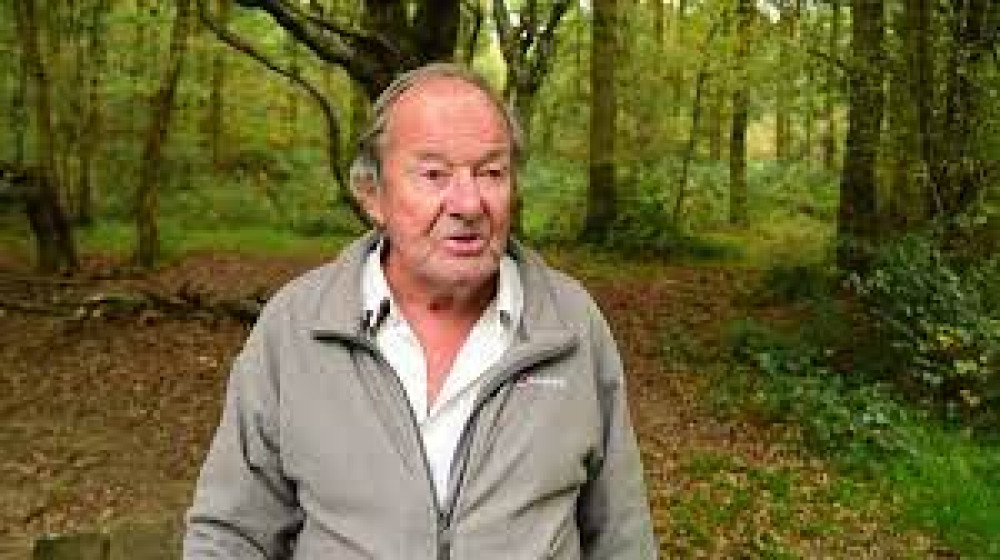
Webinar: An evening with Ted Green.
By Mark Chester
Ted Green was the star turn for this event. He proved very popular, with more than 800 people joining the event, from as far as Canada and Israel. John Parker, Technical Director at the Arboricultural Association, introduced the event and explained that the format was different to previous webinars, as there was a single speaker and no slide show. It says something of the event that, despite it being planned for an hour and a half, more than two hours later, Ted was in full flow, ideas for four further webinars had been shared and more than half of the original audience remained!
Ted began by sharing that he had begun what he describes as his life ‘with the arbs and foresters’ in the mid-1980s, and there has been an issue of the tree professional being left out in the transfer of information from the scientist to the arborist. It is clear listening to Ted that he has considerable knowledge of trees. However, he refuses to be called an Arb. He is a layman, a non-expert in a profession. This is important for him, because the layman can ask questions that a professional would feel reluctant to. He recalled being at a seminar where a ‘non-arb’ asked, ‘what is a tree?’
Conversation soon turned to the Ancient Tree Forum, for which Ted was an early member. ‘Forum’ was an important part of the name, because it is an invitation to talk. Ted acknowledged the work of Neville Fay, who led the ATF for the first 13 years. For him, the passion for our ancient trees here in the UK is special. He recalled a meeting in the early days of the Forum to consider management of the Ankerwycke Yew in Runneymede. More than 20 people had travelled from across the UK on a Saturday to attend this meeting. He observed that for such an event in Canada, people would probably face a journey of 1000 miles, rather than the shorter distances here. This Yew is special, being probably the oldest tree in the UK, at about 2500 years. It is also believed to be where the Magna Carta was signed in 1215. Ted posed the view that the Magna Carta had been used by the Americans as the basis for their Bill of Rights, and so is the basis for modern democracy.
Ted recalled the first visit by Professor Claus Mattheck, who was delighted to see so many trees present in their natural state. Ted was soon touring the UK recording trees in their natural state for Claus, who developed a database with the findings. Ted asked us consider ‘why are we felling trees’? He reminded us of Shigo’s mantra ‘to go outside and look at trees, and how they respond’.
Ted has a tendency to ask questions aimed at making his audience think, and it wasn’t long before we received one to get the discussion going: if we look at trees where dead branches have naturally broken, many will have stub ends. Why? The chat room soon took to life with comments on this. He commented that traditionally, the forester would coppice trees, not cutting the trunk to the floor, but cutting like a beaver would. When we cut with a chainsaw, we cut across the cells, but the cleaver leaves cells in tact. Is this better? He observed that if it is safe to leave dead wood in situ, we should.
Ted moved on to mention how many ancient trees there are on land owned by the National Trust, and how Jill Butler had been behind a resolution presented at the Trust’s Annual meeting to treat ancient trees on National Trust properties with the same respect as their buildings. There was a huge response to the resolution, which received more support than any previous resolution. The National Trust is now embracing caring for its Ancient trees and is helping to guide on the management of Ancient trees more widely.
Ted was asked what his favourite ancient woodland is. He explained that wood pasture is more important, citing that only six species of bird nest in woodland. He then moved on to explore why there are so many ancient trees in the UK compared to Europe, or rather, why there are so few in Europe. He suggested that the UK used coal for fuel more than on the continent where wood was the main source. He shared the observation that the rail line in Berkshire stops at Slough, and this was used to transport wood fuel, but Burnham Beeches was beyond the line and so not used.
There has been a traditional argument that timber was used for ship building. Ted questioned this view, suggesting that ships need curved timber, which is not so widely available. Indeed, the Baroques trained trees to grow with curves! Pollarding is cited as a source of timber, but he suggested it does not provide quality wood.
Ted then shared some of his own journey, which began as a laboratory technician before joining the Nature Conservancy Council in the 1980s. He was tasked with surveying oak trees at Windsor Great Park to identify which ones had dead wood present. He was collecting data on species, girth, whether the trees were hollow and the presence of stub ends. He merrily got on with the task, climbing each tree with a ladder to tag, and soon he had surveyed some 7000 trees. The emphasis was that hollow trees were dangerous. Ted began to ponder this, recognising, as someone with a background in fungi, that the hollow element was part of the natural process.
The storm of 1987 was a revelation. As Ted looked at the trees at Windsor that had blown over, he identified that all of the hollow trees were still standing. Some trees had lost their crowns, but the points of breaking were where the hollow parts ended. He observed that a hollow tree is light, with no centre, and if a tree becomes hollow, it is more subtle, there is no rigid weight. He reflected on two trees he observed at Windsor. One was an open grown Beech which was hollow and in the path of the gale. It remained standing. All around the Beech were Sweet Chestnut, which were solid, typically 15cm diameter, and blown over!
One of Ted’s frustrations is that there are so few books on fungi aimed at the arborist. He welcomed the work of Lynne Boddy, whose new book on fungi is pending. He shared his own pondering, on why hollow trees are successful. A hollow tree will have had wood decaying within it, providing fertiliser. Roosting bats and birds add to this, and roots are often found at the base.
He then explored the history of managing woodlands. The Romans introduced saws to the UK, but then took them with them when they left. We then had 1000 years of cutting by axe. Timber was not being widely grown, and during the two World Wars, 90% of the timber used was imported. The timber used for the ship compasses was harvested from hedgerows but much of the planting was from Northern Europe.
Ted then moved on to disease and how we look at it. Emphasising that a tree having fungi is not at the end of its life, he shared the observation that scientists, when looking at a disease, ask ‘what is it doing?’. They don’t tend to ask, ‘why?’. This is the question that the arborist tends to ask. As a laboratory technician, he worked in plant pathology, on plants with commercial value, mainly crops. With trees, the issues are different. Why are Oak and Ash suffering? The arborist explores stress.
Ted mentioned Agrilus, the two-spotted oak buprestid (TSOB). This has been linked to Acute Oak Decline. The insect is present at Windsor, along with its natural preditor. The oaks at Windsor are not affected by Agrilus. He suggested that the trees being affected by Acute Oak Dieback are under stress to start with, perhaps with mildew one of the threats.
He also shared his work creating a habitat for the Violet Click Beetle at Windsor, involving moving two hollow Beech trees and applying a compost mix of Beech sawdust, leaf litter, pigeon poo and a dead cat.
Neville Fay was invited to join the discussion with the topic on threats to oaks, and explained why we need to talk more about soils. Most of the studies to date on Acute Oak Dieback are based on woodland situations, not open grown trees. We need to explore the soil more, and factors such as compaction and heavy nitrification. He shared that half of a living tree is underground. He contrasted a tree in a woodland with a tree in non-organic soils in a nursery.
The question was raised, can we artificially hollow a tree? Vikki joined in the discussion, and shared her conclusions that this was not practical.
Ted challenged those who are managing our woodlands to think of themselves as foresters and not wood farmers. He also commented that Shigo saw decay as something bad, but we are increasingly looking at it as being good, and part of the natural process.
Sharon Durdant-Hollabay joined and shared about her work with roots. They are often found well beyond 12 to 15 times the trunk diameter. The Major Oak in Nottingham has roots 52 metres from the trunk. We need to share the message that life below ground matters.
Ted concluded that we should think ‘tree time’. A tree’s life will usually be beyond our life. We summarised that where possible, we should do as little as possible to our ancient trees. With the clock ticking past 8.20, and an audience of more than 400 still in attendance, the evening finally drew to a close. Ted had shared ideas for several further webinars and the webinar on soils, planned for the following week, was promoted with enthusiathm. It had been a truly memorable evening.
Other Images