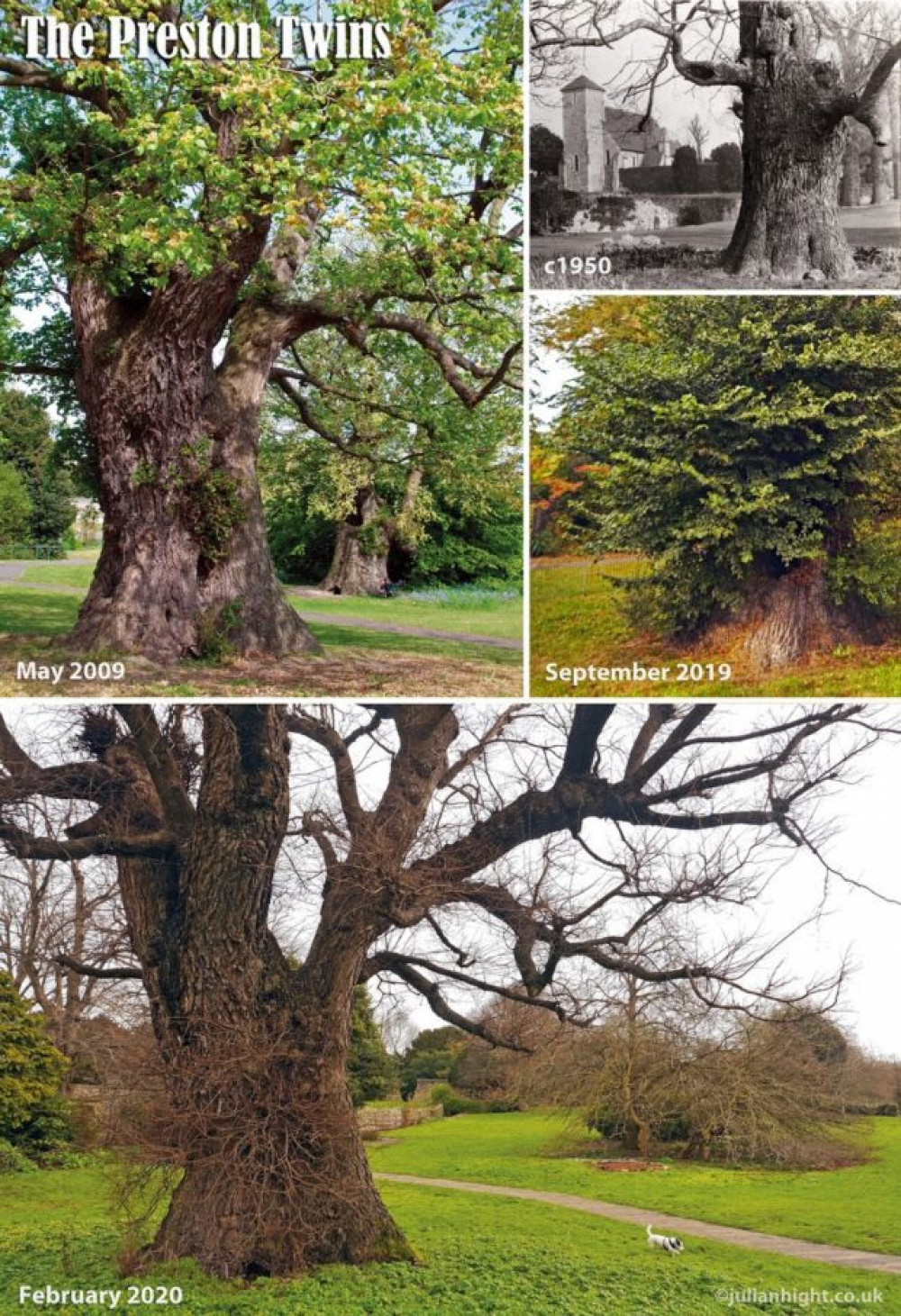
The Preston Twins – and then there was one...
By Julian Hight
2020-08-10
Preston Park, Brighton, East Sussex
As an ATF team, we have been framing our work within the themes of Recognise, Protect, Restore and Enhance. Julian Hight's blog post below is about the iconic Preston Twin elms in Brighton, recognising their cultural and ecological heritage, and how and why their very survival has been significant. Julian also touches on the measures taken to attempt to protect the trees structurally and from Dutch Elm Disease.
The city of Brighton is blessed with an abundance of elm trees. For anyone with an interest in silva, it can appear as something of a revelation. Prior to the 1960s/70s, elm was almost as common a feature as oak across the British treescape. Yet today it is estimated that outside of Brighton, around only 1,000 mature specimens of the tree survive.
Brighton hosts around 17,000 elm trees. Many were planted in Georgian and Victorian times when the city became a fashionable seaside resort. The trees adapted well to the chalky soil and salty sea air.
In 1967, Dutch Elm Disease, or DED as it is known, is believed to have come to Britain on infected rock elm timber imported from North America. A microfungal disease, it is carried by the elm bark beetle, which feeds on the wood beneath the bark, spreading the disease as it moves between trees.
Twenty-five million elms were felled nationwide in an attempt to stem the disease, which, while implemented with good intentions, had the effect of devastating Britain's native elm population. It has never recovered.
Brighton, however, took a different approach towards combating DED. The local authority pruned out infected branches at the first sight of infection, set bait traps for elm bark beetles at the city limits and dug trenches between neighbouring trees to prevent contagion through root contact. This, coupled with the natural physical barrier of the South Downs to the north, the English Channel to the south, a prevailing southwesterly onshore wind and an early warning helpline diligently used by local residents, enabled the region to retain much of its elm population.
At Preston Park, Brighton famously boasted two of the largest and oldest English elms in the world. Thought to be around 400 years old, the 'Preston Twins' stood majestically together, their rugged boles each measuring a princely 6.38m (20.93ft) in circumference. Once a common sight across Britain, the Preston Twins were the last of their kind.
In 1998, the National Council for the Conservation of Plants and Gardens awarded the city status as holder of the National Elm Collection. Eleven years later, on 5 May, two young elms from Hyde Park were planted adjacent to the pair, to ensure that their legacy continued.
For over 50 years subsequent to the DED outbreak, the twins prevailed. Then, during a storm in 2017, a large bough fell from one of the pair, exposing a chasm which revealed an entirely hollow trunk. Reduction pruning followed, and the elm appeared to recover. That is until 2019, when it was discovered that the tree was suffering DED to such an extent, that felling was deemed necessary to try and prevent the disease from spreading to its twin. It is thought that imported elm logs for local firewood brought about a recent acceleration rate of the disease.
In July, a trench was dug to sever connecting roots that linked the trees together. Then, in December, the great elm was felled and removed. Brighton had lost a national treasure, the last of its kind in the country.
The remaining shell of the bole at ground level was only a few inches thick in places, yet the thin, hollow cylinder had amply supported a vast trunk and crown for many years.
The surviving twin stands tall, in honour of its former sibling. I recommend a visit to this ancient wonder to celebrate its magnificent presence.
Words and photographs © Julian Hight
Other Images
