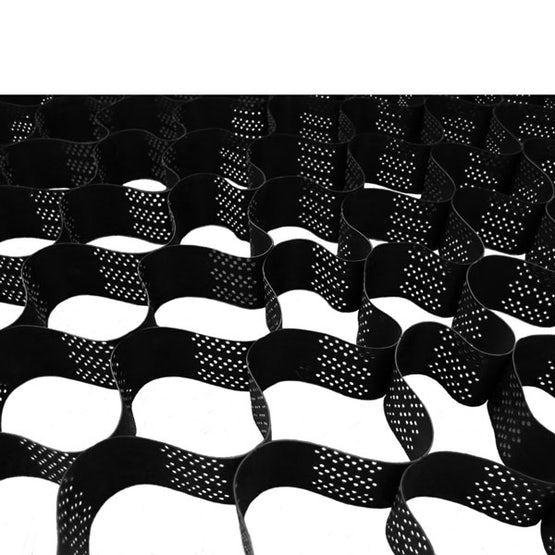
The History of Geocell
By Roy Partington
In the late 1970's Presto co-invented the technology known as cellular confinement with the US Army Corps of Engineers Waterways Experiment Station (WES). The early applications of cellular confinement or geocells consisted primarily of stabilised, expedient sand roads for military vehicles. What many people may not know about the early development of the geocell cellular confinement system is that the material wasn’t always black in colour or plastic? In fact, the early testing of a grid confinement system included wax coated craft paper; a plastic drainage pipe matrix fastened with staples; paper-thin, hexagonal glued aluminium; low and medium density recycled materials; pure polyethylene without UV stabilisation; and square cells similar to old fashioned egg carton separators.
The U.S. Army Corps of Engineers contacted Presto Products, a plastics manufacturer, for assistance in developing a stronger grid confinement system that would maintain strength under heavy loads. Working with Steve Webster at the WES Presto’s Gary Bach devised a method to weld polyethylene strips to form a cellular structure that became known as “Sandgrid” and was used by the military primarily for road applications.

Side by side cost/performance testing of a plastic geocell (termed “roadbase”) and aluminium geocells at The Waterways Experimentation Station, Vicksburg, Miss. Circa 1979
After testing various blends of resin, High Density Virgin Polyethylene worked best for weld consistency and structural strength. Since early development with the Corps of Engineers, geocells have been further improved for many other soil stabilisation applications, including the rapid construction of fortified walls in the U.S.’s Middle East combat zones starting with Operation Desert Storm in the early 1990s.
Early Testing & Projects
Camp Blanding Joint Training Centre in Clay County near Stark Florida is the primary military reservation and training base for the Florida State National Guard. In 1982 half a mile of road five metres wide was laid over sand dunes by the Corps of Engineers. The grids were laid by National Guardsmen, filled with sand, and surfaced with a bitumen emulsion spray. The whole road was constructed in twenty-five working hours and proved that the pavement system could be laid in large quantities, quickly, by inexperienced labour to a standard suitable for carrying heavy duty military vehicles.

U.S. Army Corps of Engineers testing Geoweb at Camp Blanding in 1982
Building sand roads with the Geoweb® system was further proven through a U.S. military exercise known as JLOTS II (Joint Logistics Over-The-Shore) conducted by the WES. Conducted at Fort Storey Virginia in 1983 this exercise constructed sand roads using the Geoweb system and applied thousands of traffic cycles by 100 rubber-tired military vehicles of various axle loadings. This was repeated seven times with no noticeable signs of distress.

Geoweb being laid at JLOTS ll in 1983
A second phase of trafficking was initiated, again in 1983, over the same length of geocell. Hovercraft transported 100 unladen 20ft containers from a berthed vessel to shore. The crane used for unloading the hovercraft weighed in excess of 150 tonnes and travelled along the road twice without distress to the surface. A third phase was then carried out which repeated the first.
Supplied by Roy Partington Part 2 is in next Month’s Edition