The Claus Mattheck Lectures: A Review by Mark Chester
By Mark Chester
Claus Mattheck is held in such high regard that it was no surprise that the dates for his final tour of the UK were sold out within days, and a fuller programme was soon being prepared. I was able to join the tour on Tuesday and Wednesday. Claus has a unique presentation style, one in which he works to ensure the audience remains attentive. He explained at an early stage that this was his final tour not because he is feeling his age, but he no longer wishes to encounter airports with their cancellations! Anyone remember volcanic ash? That loomed over his previous tour. This time, the challenge was the more routine cancellation of individual flights!
There have been critiques of some of the theories underpinning arboriculture, including Mattheck’s own work. He emphasised from the beginning that Visual Tree Assessment is an on-going project, with new aspects continually being appreciated. It was important, he explained, that our theories should be simple to explain, and justifiable from observations. The Axium of Uniform Stress is only present in a tree which has experienced stress. Its presence indicates problems and the need to investigate further. Its absence only indicates the absence of stress!
He spoke about lines of stress, and the shear square. There is no failure under compression, only under tension! There was a resume of the different types of fungal decay and how they can affect a tree. He explained the difference between stiffness and strength, citing steel as strong and stiff but nylon as strong under tension yet flexible. A cracker is stiff, but not strong, whereas jelly lacks both strength and stiffness. This is a most memorable analogy.
Reflecting on his own journey, Claus shared how the technology enabling us to assess tree condition has advanced. We can now drill trees to establish the present and extent of decay and cavities. Indeed, he has concluded that the mallet has only a limited role in this, and that the decision on whether to fell a tree, or not, should not be taken solely on the results of using the mallet! He was full of praise for the work of IML, without which his own research would not have progressed as it has.
Claus has added to his terminology (of the repeatable nature) the Chinese moustache and the Cupboard door. These are accompanied by a plethora of illustrations. We were treated to photos of trees whose roots had attached themselves to rocks and cliff tops. These are secure bases, whereas soil can become decidedly unstable!
Trees matter, and our veteran trees are particularly important. Claus cautioned against applying the 30% rule too rigidly; it is designed for specific scenarios and should not be used to condemn veteran trees. At the start of the week, he had visited the nearby Bradgate Park, home to some great veteran trees. Some of these are little more than shells, yet without over extended branches causing the lever arch, the risk of failure is minimal.
It is equally important that we do not seek to retain trees as habitat features when their condition makes them unsafe and they are need to roads and footpaths. Showing one such example, Claus suggested we provide a home for the beetles away from the footpath!
During day one, the lectures were interspersed with breaks, and it was soon clear these were aimed at refreshing the audience, not the lecturer, who flowed undimmed. Aware of the heat and the technical nature of the topic, Claus ensured the audience remained engaged throughout, roaring us on. As day one concluded, and Claus thanked us for our attention, and giving him our time for the day, I was left feeling privileged to have been there.
This was supposed to have been a single day event, yet such was the demand that it became a week long tour and I was able to return for day three. This time, 150 delegates were in attendance. We were treated to a different perspective, as Claus showed the principles of his work being applied to a range of non-tree subjects. These included the rubber board and a rotating apple. It says much that I made far fewer notes during this than I had on day one. We were doing well with the torture, Claus reassured.
However, it wasn’t long before trees made their return and Claus again shared about his Chinese moustache and the Cupboard. He reviewed the types of fungal decay, and the challenges presented by roots. There is no model for failure criteria as the variations are so great. Looking at the example of a Beech tree with Meripilus, where failure could happen over night or in a decade to come, he cautioned against delaying action for too long where safety could be an issue.
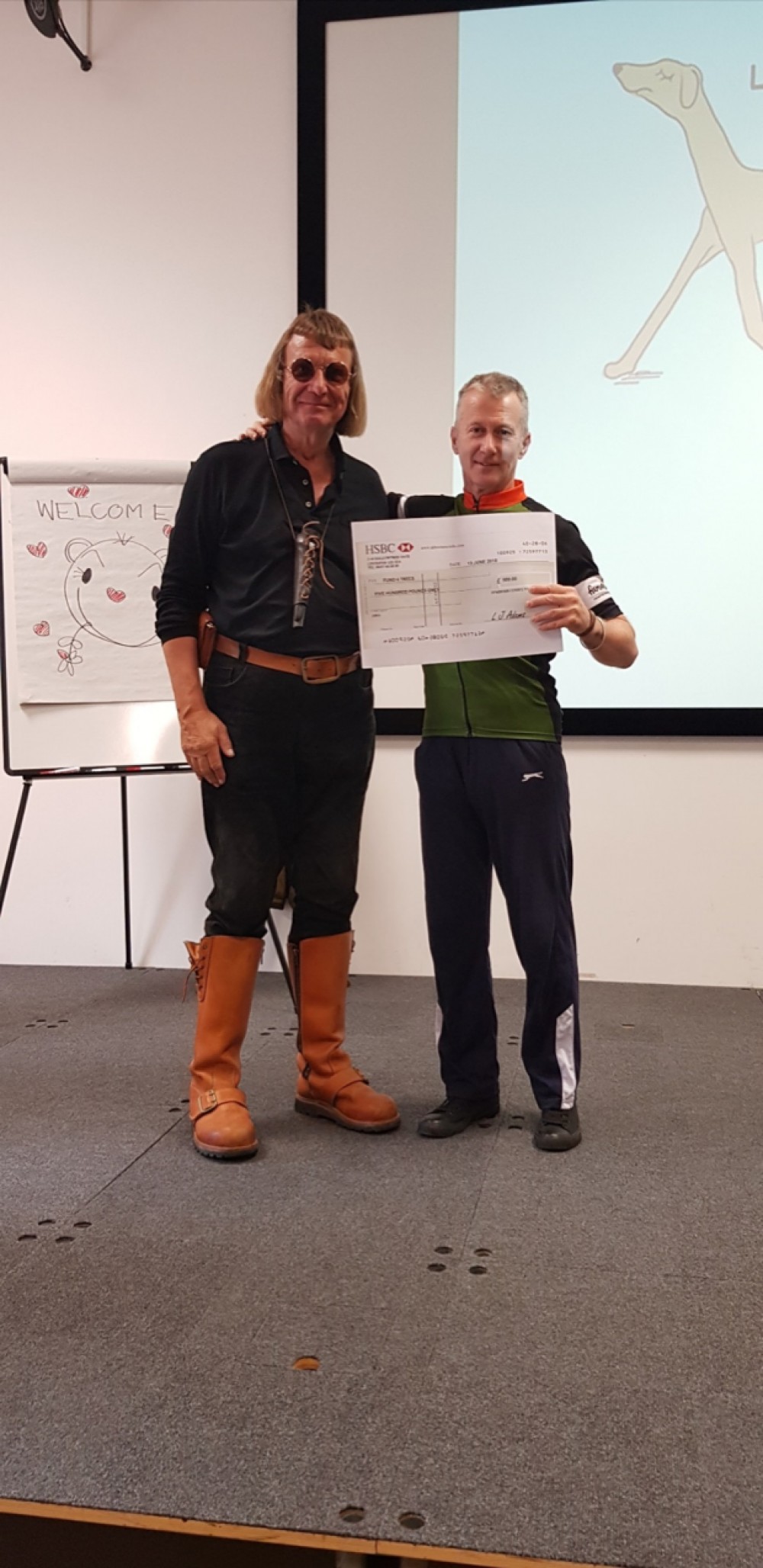
During the afternoon, Russell Ball, founder of Fund 4 Trees, which raises funds for tree-related research, spoke about its importance. He was presented with a cheque for £500 from Symbiosis Consulting.
The day finally concluded with a summary of work to date, and a reminder that we should believe the work because of what we see for ourselves, and that it makes sense, and not because Claus says so. He cautioned that simply because an idea is proposed by someone with a PhD does not mean it is sound. We should evaluate for ourselves. Only if we can understand, and explain in simple terms, should we endorse.
Whist the visit continues, this day was the most highly attended, and at the conclusion, the audience rose to applaud our speaker, for whom there is a genuine appreciation. He was presented with a momento of the visit, and our appreciation for his contribution to UK arboriculture over the past two decades. It was a moving moment!
A more detailed review will be featured in the near future.