Dr. Ferenc Divas Seminar Review
By Mark Chester
2019-06-17
Having been working with Tree Diagnostics on this event since last autumn, it was great to finally meet the man. Ian Barnes of Tree Diagnostics introduced the day and explained that a key reason for using the various piece of equipment is to make more informed decisions on tree management and to enable trees to be retained for longer.
Dr. Ferenc began his professional career 33 years ago working at a nuclear power station in Hungary, undertaking non-static testing. After 7 years, he returned to his home city of Vienna. There was no nuclear power station to work at, and so he needed to find another outlet for his skills. He joined the University of Forestry and Wood Studies where he began to work with foresters. He soon appreciated that wood is very complicated! He was then offered the Cochrane Fellowship in the US, where he was tasked with non-destructive testing of roots and predicting the strength of timber beams.
Dr. Ferenc realised that the speed of sound is a good predictor of the strength of timber, being able to detect decay. In 1993, he began to do more trials on trees to better understand what was happening. He then founded the Fakopp company. The choice of name indicates some of the challenges he faced, especially operating in an English-speaking world but with Hungarian as his mother tongue. Woodpecker was the first choice, but colleagues in the US suggested it was too long and not everyone in the US would associate the name with a bird. He returned to his native Hungarian and chose Fa, meaning ‘Wood’ and kopp, meaning ‘Knock’. The first tool was the Microsecond Timer.
An event in Budapest raised the profile of trees and their safety, and the help that Dr. Ferenc could provide. After a storm, one particular tree had remained standing. Then the next day, it failed during light winds. He acknowledges that he is not an arborist. The arborist is familiar with VTA, but his skill is in interpreting data. He recalled an occasion, some 25 years ago, when he was given a guided tour of a park by rather sceptical arborists. As they passed a Poplar in a busy part of the park, he decided to use the Microsecond Timer. It indicated a problem. The group dismissed this as nothing was evident externally. Then they decided to explore further, clearing the base of the trunk from foliage and finding a small hole in the bark. A probe revealed this to be a cavity and the team soon realised that the tree wasn’t safe. It was the only tree on the site (120 were tested) that was unsafe; there was notable appreciation for Dr. Ferenc.
The Microsecond Timer can detect where holes, cracks or decay is present, between 2 points. this being the case where there is decay. However, on one occasion, Dr. Ferenc did identify a limitation to the approach. He was asked to test a tree with a suspected cavity. The reading was for sound timber, but the tree was hollow. Further investigation showed that the cavity was filled with ice. He concluded that the acoustic test should not be used below -5C!
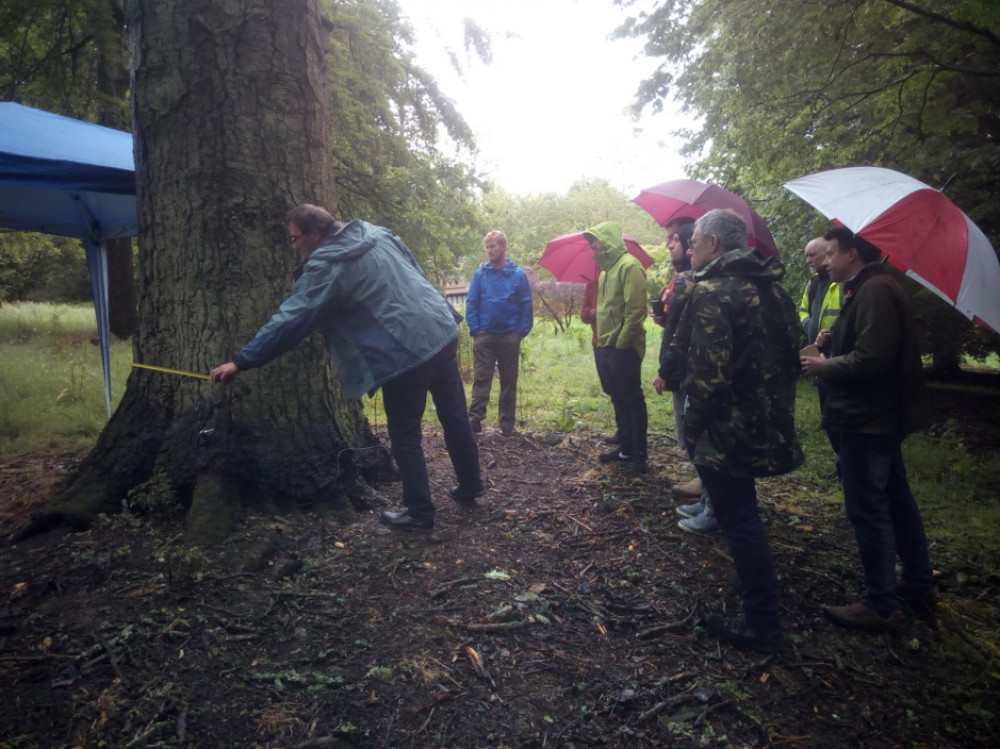
The weather wasn’t kind to us, but we were soon outside looking at demonstrations. The first trial tree was soon being wired up and subject to the acoustic Arborsonic tomography test (sonic tomography) . The tree had been chosen because it is the oldest tree at Batsford, pre-dating the time of the Arboretum. The data collected provided reassurance. Then we moved to the pulling test. This had caused some intrigue when we were arranging the demonstrations, with at least one expression of concern that we were planning to pull a tree over. Indeed, when I discussed this idea with one arborist with whom I work, the response of getting the Landrover ready with some rope made it clear that the approach wasn’t understood.
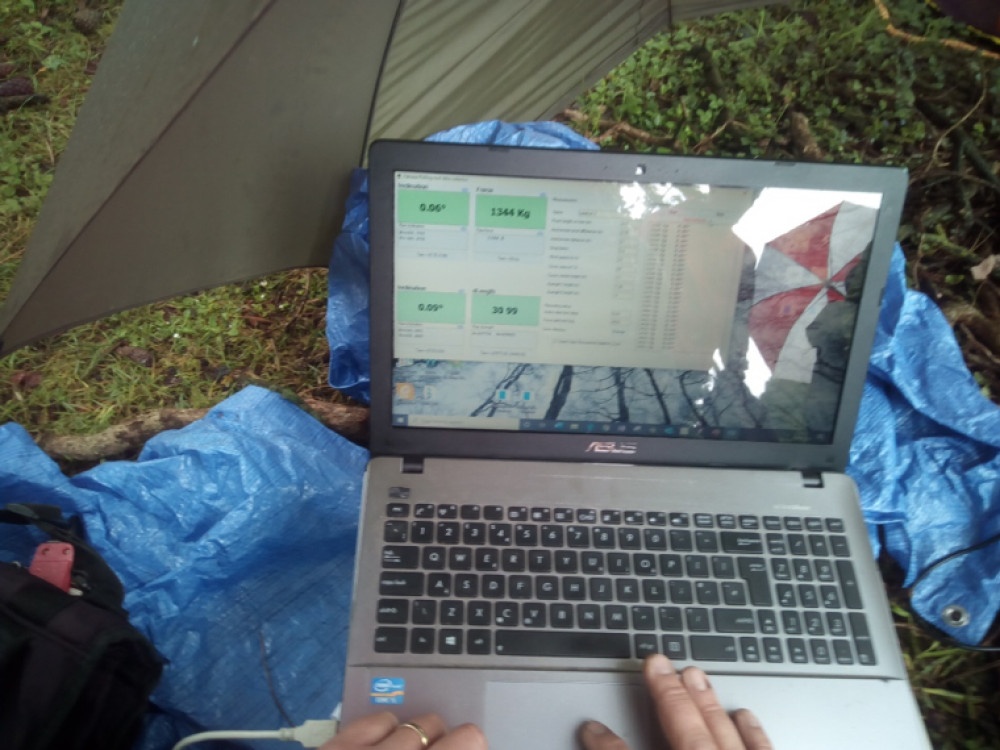
The pull is very small. In fact, if it were applied to the 55m tall Leaning Tower of Pisa, the movement at the top would be about 1mm! The controlled pull works by applying a very small force load until reaching 0.2 degrees of inclination or winch capacity, whichever comes first to the trunk and measuring microscopic responses in the wood fibres.
An alternative is the DynaRoot. This uses a pole with anemometer to measure on site wind speed at 10m above ground. The respond of roots to the wind for up to 10 trees (if you have x10 sensors) is then measured using a dual axis inclinometer, fixed to the root collar and data collected. There is no pulling, rather the tension within the roots is measured. Weather conditions were against us, and every time the sky got lighter and the rain abated, this provided only temporary respite. The remaining demonstrations continued in door.
Several of those attending were familiar with the various technologies, and this enabled some detailed and in depth discussions to take place. Commenting towards the end of the day, Ian Barnes observed that the more he learns about trees, the more he appreciates how little is known, and how the decisions he took 25 years ago would now be reviewed. The spontaneous round of applause was evidence of a day of good learning and conversation.
Tree Diagnostics is now working to bring more of the teaching to the UK audience. This day was, but a taster.
Other Images