DO WORMS HAVE A ROLE TO PLAY IN SOIL DECOMPACTION WITHIN URBAN LANDSCAPES?
By By Dr Glynn Percival (Bartlett Tree Research Laboratory) & Mr David Challice (Challice Consulting Ltd)
2021-07-12
Soil compaction within urban landscapes caused by anthropogenic activity (building, construction development, installation of underground infrastructure, traffic, pedestrians) is negatively associated with soil quality.
Problems associated with soil compaction include physical impedance to root growth, reduced levels of aeration, reduced soil pore continuity and pore space, increased thermal conductivity, a tendency to winter waterlogging due to slowed water infiltration, and summer drought due to low moisture holding capacity, reduced nutrient availability and increased disposition to root borne disease such as Phytophthora. Consequently, soil compaction can prove a major constraint to urban tree establishment following out-planting and a primary cause of decline of established mature trees.
To remediate soil compaction a number of management strategies can be adopted to include air spading, vertical mulching and/or the use of the Vogt system. While these systems have proved to be effective, they can be time consuming and expensive. These limitations mean that soil de-compaction is generally limited to small areas of soil i.e., from the base of the tree trunk to the canopy dripline. In many cases, however, urban tree managers find themselves in situations where large scale i.e., >1000 square metre areas need to be de-compacted. In this situation soil de-compaction technologies become prohibitively expensive.
Worms
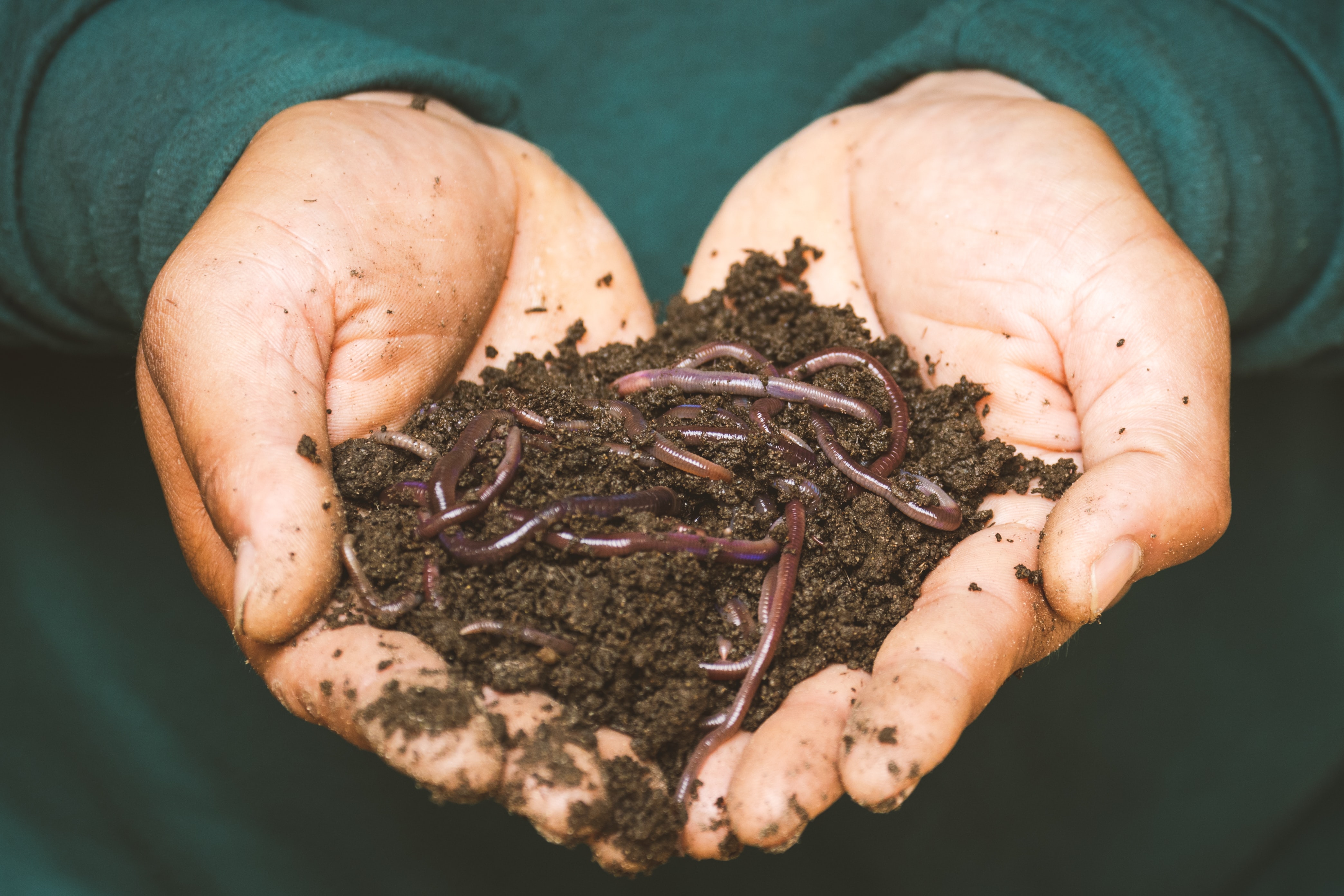
Within a woodland or forest soil de-compaction naturally occurs primarily due to the action of earth worms. Earthworms are recognised as “ecosystem engineers” because of their physical and chemical roles in pedogenesis (soil formation), decomposition and nutrient recycling. The artificial introduction of earthworms for improving soil fertility of agricultural land has been a common practice for many years. Earthworms eat leaf mould, decomposing wood particles, dead insects, and organic matter.
As the materials pass through, their digestive systems they are “broken down” and excreted as worm castings, a biological form of nitrogen freely available to plants. Earthworms can also reduce soil compaction and improve soil structure by creating tunnels and burrows that aerate soil and allow water to percolate more readily. Research has shown, for example that addition of earthworms to soil can improve porosity by 400 percent.
The practice of introducing earthworms for the purposes of de-compacting soil in urban landscapes has received little attention. Of that available research by the author has shown that if a 100 square metre area is de-compacted and amended with organic matter to include a woodchip mulch layer when worms are introduced a population rapidly builds up within the de-compacted area. Overtime the resources within the de-compacted area such as nutrients and space become limited.
Consequently, the worm population then needs to source resources out-with the de-compacted are. This results in a slow but steady outward movement from the de-compacted into the compacted soil. Given the burrowing and tunnelling nature of earthworms then, overtime, the compacted soil slowly becomes de-compacted and soil fertility increases. This in turn means that tree root systems also have a greater soil volume to exploit which results in an increased rooting area.
An example of this can be seen in Photograph 1. The area on the left represents a de-compacted soil with a nitrogen fixing clover crop cover. The area on the right represents a compacted soil. The presence of worm casts can be clearly seen on the surface of the compacted soil showing that the worms are moving from the de-compacted soil into the compacted soil and by default, de-compacting it.
Evidence for this can be seen in Table 1 based on data from a trial site located at Stockey Park, Uxbridge, Middlesex when a vista of mature Limes growing in heavily compacted soil were de-compacted and worms added. Measurement of root density out-with the de-compacted area where worms have been added increases from 0.0011 to between 0.0187-0.0311 grams per cm3. This represents a 1600-2700% increase in root density!

Table 1. The Influence of Soil De-Compaction, Wood Chip Mulch, Worms and Clover on Root Density of Lime (Tilia x europea).
|
|
Root Density (dry mass g per cm3) |
|
|
|
Under the canopy (de-compacted soil) |
1 metre outside the canopy area |
|
No treatment (control) |
0.0019 |
0.0011 |
|
Soil De-Compaction + Mulching |
0.0244 |
0.0008 |
|
Soil De-Compaction + Mulching + Worms |
0.0218 |
0.0311 |
|
Soil De-Compaction + Clover |
0.0324 |
0.0009 |
|
Soil De-Compaction + Clover + Worms |
0.0220 |
0.0187 |
Photographs 3 and 4 show the results of de-compaction plus worms at year three after treatment i.e., improved visual appearance, enhanced crown coverage, reduction of leaf yellowing and chlorosis, improvement in leaf photosynthetic efficiency, increased stem extension and girth increments and reduced crown die-back.


Photograph 3 Photograph 4
A Few General Rules
Simply digging a hole and adding worms to a heavily compacted soil will have little effect. The soil needs to be amended as follows:
1. Incorporate organic matter (manure, compost, leaf mould etc.). Aim to enhance soil organic matter to between 3-5% or higher.
2. The soil should be de-compacted until a compaction or bulk density level of between 1.35-1.50 is reached.
3. A woodchip mulch layer over the de-compacted surface is strongly recommended.
4. At least 10-15 square metres of soil should be de-compacted for every 100 square metres of compacted soil.
5. Use only native earthworms such as Dendorobaena veneta and Lumbricus terrestris.
If points 1-5 are followed, then data obtained to date indicates worm movement out of the de-compacted area into the compacted area ranges from 1-2 metres per year.
Conclusions
Over the past five years a range of soil de-compaction trials combined with soil amendment with earthworms have shown that worms offer potential as a long-term sustainable treatment to de-compact large areas of soil. Only native UK worm species should be used. Over-time improvements in tree health become manifest as enhanced leaf colour, increased root growth and reduced canopy die-back.