Deep Planting: unearthing the truth.
By Mr Sean Graham and Dr Glynn Percival
2020-04-01
Bartlett Tree Research Laboratory, Cut Bush Lane East, Shinfield, Reading.
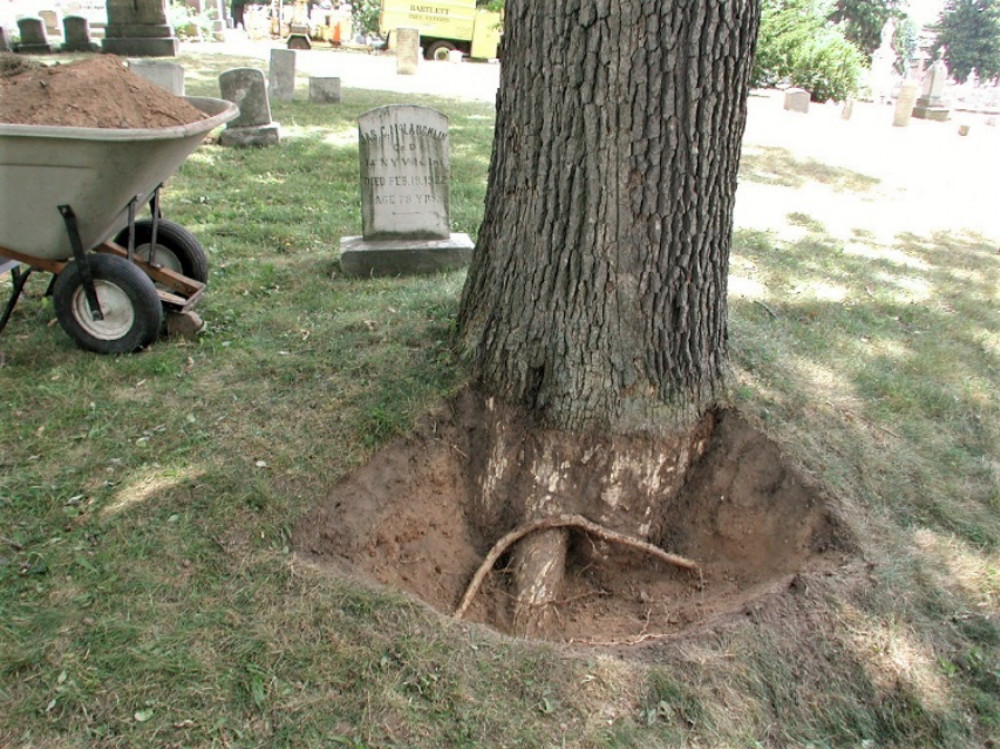
It is now widely recognised that deep planting i.e. planting trees with their root-collar buried has long-term detrimental effects on tree health and survival. Despite this, hundreds of thousands of trees are still planted too deep on an annual basis within the UK even though tree planting guidelines (British Standards, International Society of Arboriculture, Royal Horticultural Society) all state that the root flare should be clearly visible at the time of planting (Figure 1). The tree stem/trunk tissue is not adapted to being exposed to a constantly moist and low oxygen environment that is formed when soil is covering the root flare. This causes the tree to become stressed and infection by Phytophthora and Armillaria root decay pathogens becomes more likely. Other secondary invaders like cankers and boring insects often invade the root collar of stressed trees and cause leaf yellowing, premature leaf drop and crown dieback by reducing the nutrient and water availability through damage to the conducting tissue. Similarly, girdling roots are more likely to form when a tree has a buried root collar, which can restrict the movement of water and nutrient to the crown as well as hormonal communication between the crown and roots. Particularly sensitive tree species to girdling roots are those with thinner bark including: Maple, Ash, Birch, Cherry, Apple and London Plane.
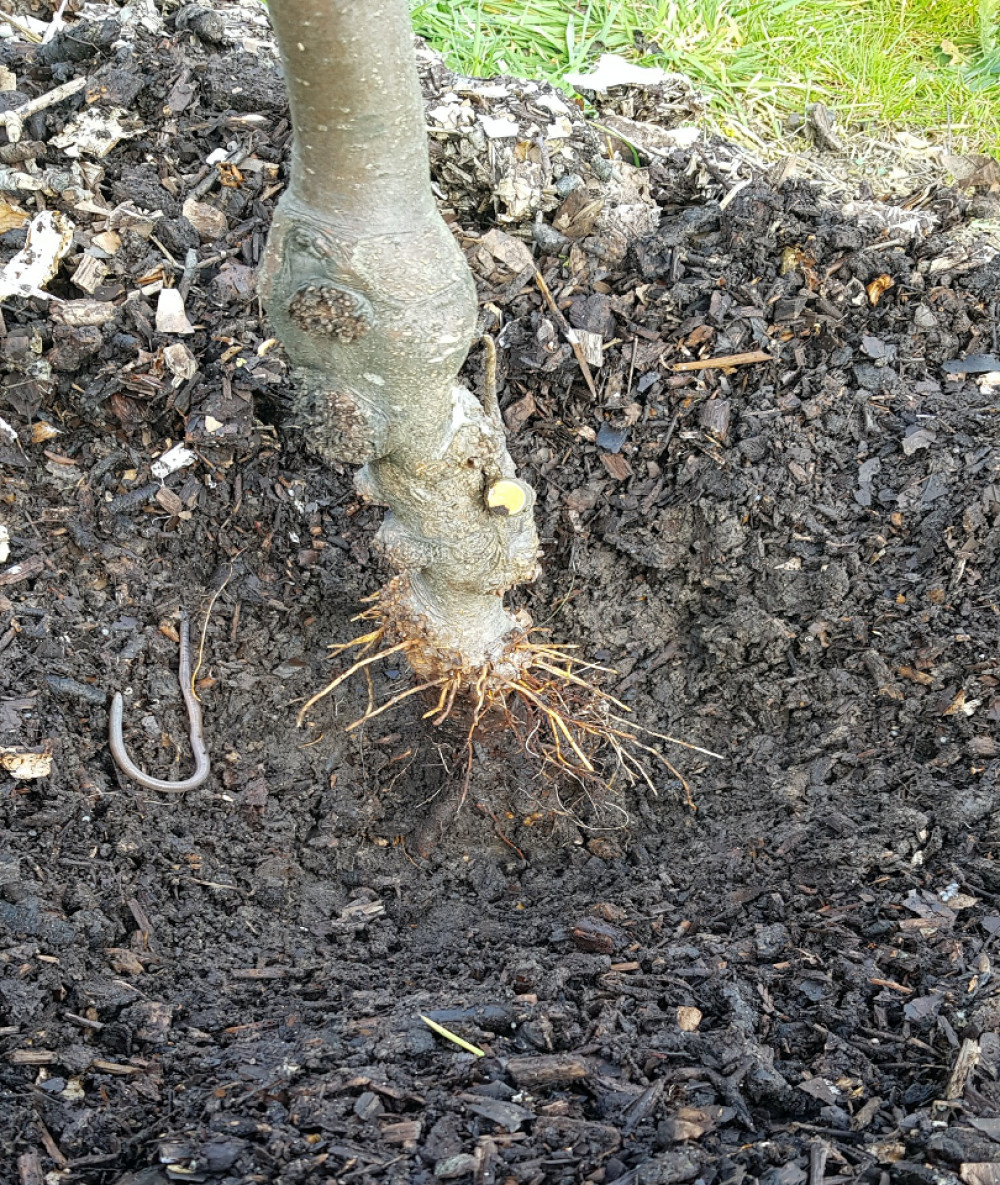
Deep planting can be alleviated through a process called root collar excavation (RCX). This uses an air-spade to break up the ground using compressed air from a compressor with minimal damage to fine roots. Once the soil is removed from around the trunk of the tree and the root collar and buttress roots are exposed, the bark in these areas can dry and the risk of disease infection through the aforementioned routes is reduced. If girdling roots are encountered during this process, these should be severed either side of the root that is being constricted using secateurs, loppers or a handsaw unless tree stability is likely to be jeopardised. Fibrous roots above the buttress roots should also be removed (Figure 2).
Once RCX has been completed, it is important that suitable aftercare procedures are observed. These include:
A woodchip mulch should be applied to a depth of 5-10 cm extending to the canopy drip line if possible and ensuring that the root collar and buttress roots remain uncovered.
Fertilisation and pH amendments based on the result of a soil analysis should be applied along with a phosphite based fertiliser to assist with the recovery of the tree.
During dry periods, irrigation should be applied away from the root collar. Most young trees require 20 L of water every other day during the height of summer but it is strongly advised to monitor the soil moisture at various places and adjust the irrigation if necessary.

Figure 1. Deep planted Oak tree. Photo credit: Dr. Kelby Fite. Bartlett Tree Experts.

Figure 2. A deep planted Apple tree has produced adventitious roots above the root collar which should be removed. Photo Credit: Mr Sean Graham. Bartlett Tree Experts.
Other Images