CAS at Windsor reviewed (and TPO update)
By Mark Chester
2018-12-10
CAS at Windsor: A Review
On a rather dull Friday in November, members of the Consulting Arborist Society gathered at The York Club in Windsor Great Park for a guided tour. Planned as the focal point for the Annual Meeting, it soon became clear that the tour was the main event. Which is the way it should be! The day was co-led by Ted Green and Bill Cathcart, the latter a former Park Superintendent who was on hand to provide insight into a number of management decisions.
We began with Ted and Bill sharing about the history of the site. It became a Royal Park during the reign of Henry ll, who first really appreciated the potential for hunting. The Park then was considerably larger than it is today. It experienced a range of uses, including during the reign of George lll, known as ‘Farmer George’ for his ‘hands-on’ approach to farming and land use.
Ted emphasised that Bill was the first arborist to be employed to manage the site, and his legacy remained. Bill came to Windsor from Richmond Park, where he was the Park Superintendent for 10 years. He previously spent time as a tree officer. He was specifically employed to guide the management of replacement of an oak avenue which dated from the reign of Queen Anne, and before.
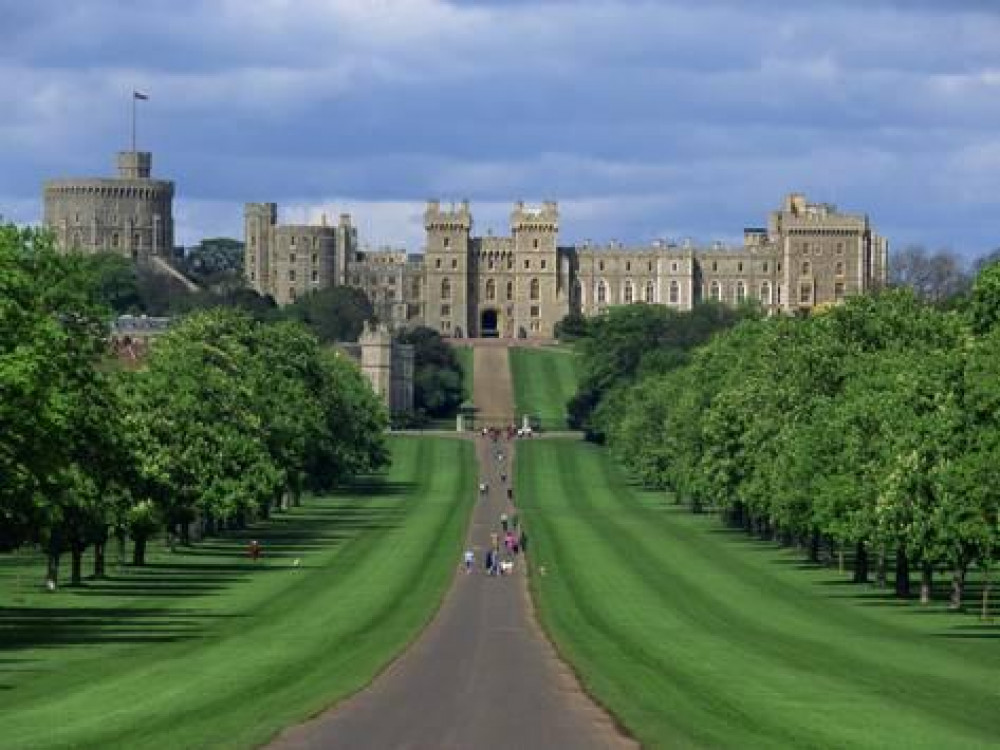
We set off to this venue, and were soon presented with an amazing view, even on a wet and dull day. The avenue stretches for more than two miles and some of the individual trees are more than 500 years old. There are two schools of thought when it comes to managing an avenue of trees. One is to seek to retain as many of the trees as possible, focusing new plantings on in-fill. The other is to clear the site and start again. Prince Philip, Duke of Edinburgh and the man ultimately responsible for this site, favoured the latter view, to clear fell and start again. Prince Charles preferred to work with the existing resource.
The clear fell view was being implemented, and causing some local anguish. The decision was taken to employ Ted as a mediator, a focal point. Bill was employed to manage the project. His careful touch was soon apparent. At one high point, where the avenue widens in to a circle surrounded by Lime trees, Bill suggested it would be preferable to retain them, making a personal observation that they were not in the first flushes of youth. His view prevailed, and these trees are still in place, providing a connection to the past.
A statue of Queen Elizabeth ll is in place by the Lime trees, showing her on horse back. She is only the second monarch to have a statue erected during her reign (the other monarch is Queen Victoria).
Ted then took us to view a Beech tree which previously had Meripilus present. It has experienced a regeneration in root growth. Ted wish to emphasise that this fungi should be regarded as part of the natural decay process and not a pathogen. It degrades dysfunctional wood, it doesn’t attack a healthy tree.
We passed some trees attributed to Charles ll. When he was fleeing the army of Cromwell, it is said that he hid in an oak tree. In exile in France, he collected a trunk of acorns. Most were Quercus robur but five rogue Sessile acorns possibly were in the group, and the collection of oaks in the park includes 5 Sessile specimens! We could, indeed, see history coming to life.
Then it was on to explore an area of wood pasture with hollow trees. Ted was able to share of his research on hollow trees, and how he recognised that they seemed to withstand storms. The prevailing view at the time was such trees were unsafe, and the presence of fungus made a tree diseased. This view is now recognised as limited. We saw the Attenborough tree (in which Sir David was once filmed for The Private Life of Plants). There was interesting discussion about the potential history of some of the trees, the challenge of bracken and whether one particular tree may have been pruned, or not.
We now got an insight in to the management approaches that Bill had implemented. The area had been used as a picnic and parking spot for visitors to the park, with compaction becoming an issue. The careful use of planting and redirecting parking to other areas had ensured that proper management was back in place.
The tour took in some of the new planting of the oak avenue, and we were able to assess the vigour of plantings, including some trees transplanted from elsewhere within the site.
After a superb lunch (our hosts must be used to catering for the best!), we set off for the afternoon programme. We began with a visit to the Conqueror Oak. This tree has been dated to more than 1000 years. A DNA analysis back in 1990 dated it to 1035 years! The spreading branches have been propped, using steel props, rather than wooden one. When I visited in the summer, Ted hadn’t known why this was. With Bill on hand, we were soon informed that wood twists easily and decays so that support positions can easily be lost. Steel lasts longer and is better.
With the light fading, we went to the final part of the tour. Back in the summer, Ted had shown me around an area where the creation of dead wood habitats was being explored. He has recreated standing dead wood Beech, branch tears and creating dormouse nests in raised stumps. As we explored, it was becoming increasingly clear that the audience was really enjoying the tour. We departed in the twilight having enjoyed a very special day. There was appreciation for the work that Bill has done, and that this project continues. Thank you to Bill, and thank you to Ted. He reminded us that he is ‘not an arb’. Whilst he is as knowledgeable as the rest of us, he enjoys a flexible role, and the opportunity to promote his pioneering ideas to the professional arborist. I, for one, value this. Thank you.
The oak avenue. It was the management of replacing it that brought Ted and Bill together at Windsor
A statue of HM Queen Elizabeth ll (=Above) and secondary growth in Beech following Meripilus
An oak planted by Charles ll
Ted shares about hollow trees!
The 1000-year-old Conqueror Oak. Respect is due! (about 1050 years old now).
Ted’s research centre!