Bill Cathcart in the Spotlight.
By Mark Chester
2019-05-22
Last summer, when I was organising the CAS at Windsor Great Park outing with Ted Green, he suggested that the day would be enhanced if Bill Cathcart, the now retired Park Superintendent, could join us. Ted spoke highly of Bill, and one of the members, who attended, shared an excitement at the prospect of a day with him. I was looking forward to meeting our guest.
Bill is a quiet and unassuming gentleman who shared wonderful nuggets throughout the day. He explained the thinking behind numerous management decisions, and made the day a really informed occasion. As Ted praised the contribution of our guide, it was soon apparent that Bill’s own arboricultural journey was worthy of sharing more widely.
There has been more than an element of serendipity to Bill’s journey to Parks Superintendent at Windsor Great Park. Born and living in South West London, there were few early signs that one day, Bill would spend a large part of his working life in the management of two of the most visited historic deer parks in England. Bill’s first job on leaving school was for Carters Tested Seeds. He was guided to Carters by way of the local Youth Employment Office. Although having no particular interest in the distribution of seeds, bulbs, corms and tubers to Britain’s gardeners, he enjoyed the job, recalling that one of his tasks was to take samples from suppliers’ consignments and have them planted out in the extensive trial grounds where the mature plant is quality assessed during the flowering period. Carters was a world away from life today, and Bill recalls being at a raised desk sitting on a high chair entering plant records in leather bound ledgers, saying all he was short of was a quill. The company no longer exists and the beautiful trial grounds together with the Victorian buildings, have made way for the appropriately named Carters Housing Estate.
Bill’s early brush with horticulture came to an end after a couple of years. He became a bit restless and had several jobs, including a short period with BOAC (then the principal British airline together with BEA) and a longer spell with British Rail, where he worked on the Signal and Telegraph Department. Those were the days when most of the railway signalling was mechanical with staff in signal boxes pulling levers, but alas, it is all colour light and computers now. A more unusual and for some an enviable job, was working in a brewery. Staff had a ration of a couple of pints a day but as it was unmentionable gaseous brand he preferred to have a pint of proper ale in the Young’s pub around the corner.
Once again the outdoor life beckoned and, despite being rather ‘green,’ Bill managed to get a gardener’s job working for Merton Council in a park on the edge of Wimbledon Common. Cannizaro Park has a collection of a rare and unusual trees and shrubs and, captivated by these plants Bill had unwittingly set himself on a lifelong association with our woody friends. Fate played a further part in a chance meeting with the now notable garden designer Ivan Hicks. Ivan, having worked in Cannizaro the previous year, was just finishing an arboricultural course at Merrist Wood Agricultural College and recommended Bill should give the course a go.
Supported by a government ‘Tops Grant,’ available to adults who wanted to retrain and learn new skills Bill spent an intense but pleasurable year at Merrist Wood Agricultural College. Lecturers at the time included Peter Bridgeman and Derek Patch. The one year arboricultural course had been running for just three years and as well as the continually assessed course certificate, Bill also obtained the RFS Certificate in Arboriculture. Bill thrived, and left to work for the old Ministry of Agriculture, Fisheries and Food (MAFF), working at Kew Gardens. Employed as a tree surgeon maintaining one of the most important tree collections in Britain could have proved pretty daunting, but, supported by a dedicated and understanding team, Kew proved to be the ideal environment for rookies to find their feet. These were the days when remedial techniques were often invasive and Bill was soon busy filling in cavities, drilling holes for drain pipes, inserting cable screws and bolts and cleaning out crowns. He recalls these days with a bit of a cringe. Life has changed so much since those days
After two years, Bill left Kew to join the exodus of tree surgeons travelling to West Germany to work. At this time, in West Germany, it was difficult to get home grown climbers for one reason or another and the work, being reasonably well paid, was gratefully taken on by British climbers. The tree work was being well funded by Government and Local Authorities, with much of this being spent on cable and rod bracing, leaving some trees looking more like a radio mast!
Following Germany, Bill was employed in Richmond Park. It was here that he had first-hand experience of working on ancient trees, primarily oaks. It was 1978, still early days in our understanding of the specialised management of these trees, and it is with some foreboding that he thinks of some of the work carried out in the name of best practice at that time.
After less than a year in Richmond another move came, to Winkworth Arboretum, a National Trust Property a few miles south of Guildford. Bill was appointed Head Warden of the collection of more than a 1000 varieties of trees and shrubs. Set in the picturesque Surrey Hills, it offers stunning combinations of colour with every changing season and a number of other naturalistic delights. However, he cautions, before we get too excited he and one other managed the trees and also litter picked, emptied the bins, cleaned the toilets and supervised the car parking at weekends. That aside, Bill emphasised it was a most enjoyable and satisfying job.
Bill enjoyed the role, and stayed for four years, his longest posting to date. However, he knew deep down that the role would not progress his career and his own knowledge of trees was limited. Reading the forerunner of Horticulture Week, The Gardener’s Chronicle, he saw an advertisement for a Tree Officer at Dartford Borough Council. He applied and was appointed. He was soon managing the Council’s trees and dealing with TPO applications. The experience gained at Dartford enabled Bill to sit and pass the RFS National Diploma in Arboriculture, the forerunner to the Professional Diploma, now the Level six Diploma.
The London Tree Officers’ Association (LTOA) started at this time, and, although Dartford is outside London, Bill was welcomed as a member. A long serving member of the Arboricultural Association he became more active in attending meetings and conferences including those at prestigious Universities such as Southampton and Liverpool in the early 1980’s.
In 1985, with more than a decade of experience in arboriculture, Bill became aware of a position at Richmond Park, as Assistant Parks Manager. Following a successful interview, Bill was appointed. He was now charged with managing a 2500 acre 17th Century Deer Park, with a staff of fifty and an estimated 2.5 million visitors a year strolling through parkland, home to one of the most important assemblage of ancient trees in Europe. While the Park had regulations in regard to visitor control in the park, there was not a great deal on the management of the trees. There was dedicated tree gang mostly carrying out reactive work and following the storms of 1987 and 1990 this did not change!
However, due in part to a government decision in 1992 to use contractors to replace Park employed staff, a tree survey was carried out and plans were produced to manage the park trees. These were fairly rudimentary and Bill was pleased to say that now further excellent survey work has been carried out and that a dedicated arboriculturist is employed in Richmond Park.
It was in 1993 that, with a group of fellow enthusiasts, Bill helped to found the Ancient Tree Forum, with his good friend Ted Green. He was also a founding Trustee of the ATF, a position he has recently stood down from. Richmond provided a good base for Bill to showcase best practice and demonstrate the qualities of some of the trees within the Park.
It was during the summer of 1995 that The Crown Estate posted the advert for the post of Parks Superintendent of Windsor Great Park, brought about by a retirement. Being reasonably familiar with the Great Park, having visited on several occasions, Bill thought that approaching fifty years of age and with young children and an understanding wife, it was worth applying for. If successful, it would hopefully be his last move. A couple of interviews and three months later Bill was ensconced in Windsor Great Park.
Bill explained that Windsor Great Park is unique in being the only Royal Deer Park in the portfolio of The Crown Estate, whose principal land based rural holdings are mainly plantation forests and farms. Windsor Great Park, although a Royal Park is not one of the London Royal Parks, such as Richmond, which are the responsibility of the Government, although now run by a trust that is grant aided by the Treasury.
Bill rather fell in at the deep end when taking up the Great Park post in 1995, as, at the time, there was a wave of protests going on around the country concerning the removal of trees. Well organised demonstrations held up work on the Newbury by pass and Manchester airport while at Windsor the restoration of Queen Anne’s Ride, an early 18th Century Oak avenue, was of popular interest as differing views from various members of the Royal Family excited the tabloid journalists.
The 2.4 mile single row avenue was planted as a landscape feature and was traversed by Queen Anne in her carriage to gain access to the lower forest where she enjoyed the excitement of the ongoing sporting pursuits. As is often the case with such a feature, some of the trees were in a state of decline and over the years, the Ride had lost its integrity. Large gaps had appeared and, for no obvious reason, a mixture of lime species had been planted as replacements for moribund Oak. One of the management options for an avenue of trees when seeking renewals is to fell and replace. This may involve the loss of healthy trees, and the replacement of individual trees on a piecemeal basis can make it difficult to replicate the original feature.
However, the removal of trees was proving controversial and Bill recalls that, on his arrival, the felling was all but complete, with the exception of a number of semi mature oaks and limes. Rather than have these felled, a large tree spade was hired and the limes were replanted at other locations. Some were gifted to the local authority, and the oaks were repositioned to form a uniform entity within the avenue. Some replacement planting was happening, but it tended to be sporadic. With close to a thousand trees to go in, it was important, as a matter of public relations to get the work completed and to ensure an effective maintenance regime, including watering, was in place.
It is to Bill’s credit that the angst being generated prior to his appointment was defused. At the highest point of the avenue, surrounding a statue of HM Queen Elizabeth ll, is an original feature of a Lime circle. The plan had been to fell and replace the Limes. Bill suggested that their retention was preferable. They still stand. As for the avenue, the trees are thriving, so hopefully, by the beginning of 22nd century, visitors will be admiring a wonderful mature oak avenue and blessing the foresight of past generations.
The ancient trees of Windsor were recognised as being of historic value, but were generally not treasured Many were removed or neglected to make way for farming and forestry interest, as was the case on many estates throughout the country. In more recent times they have been protected more for their wider conservation importance. Part of the woodland had been designated as a Nature Conservation Area, as long ago as the 1950s, by the then Nature Conservancy Council. The high value of fungi found among the trees was such that part of the estate was designated as a Site of Scientific Interest (SSSI) in the 1980s, and Ted Green was actively promoting the asset within. Progress was slow.
One of the challenges Bill faced was that tree work was not considered a specialist discipline and tended to be carried out by a mixture of staff willing to do the work with some appropriate training. However, changes were implemented and tree work became a stand alone section of well trained skilled arborists including a specialised tree inspector. Bill mentions one of his most satisfying achievements was to introduce conservation grazing onto the wood pasture. Back in 2003 six Longhorn cattle were introduced to Brooks’ Corner, an area of wood pasture with wonderful ancient oak dotted throughout. The area was in desperate need of management, especially from the detrimental effects of bracken, which was also a fire risk. Fifteen years on, with the herd expanded and grazing other wood pasture areas, the initiative has turned out to be a great success.
Bill was pleased to say that the vast majority of ancient and veteran trees have now been plotted using GPS, and a more integrated management plan has been adopted. New plantings are undertaken with purpose, and trees maintained post planting. It is regarded as being an important part of estate management. The geriatric trees (as Bill heard someone call the veterans), that were viewed as a side line, are now recognised as an important asset. There is a legacy here. Bill finally retired in 2011, returning on occasions to assist with tours and quietly observe what is going on.
Bill has developed on the work of Ted, who speaks highly of him. Ted remains active within the Park, which is still his home. One senses a symbiosis here, for without Ted’s foundational work, there would not have been the awareness of the ancient tree asset. Yet Bill, as Superintendent, was able to implement ideas and best practice. He was able to develop an estate-wide management approach and raise the profile of trees generally, and ancient trees specifically.
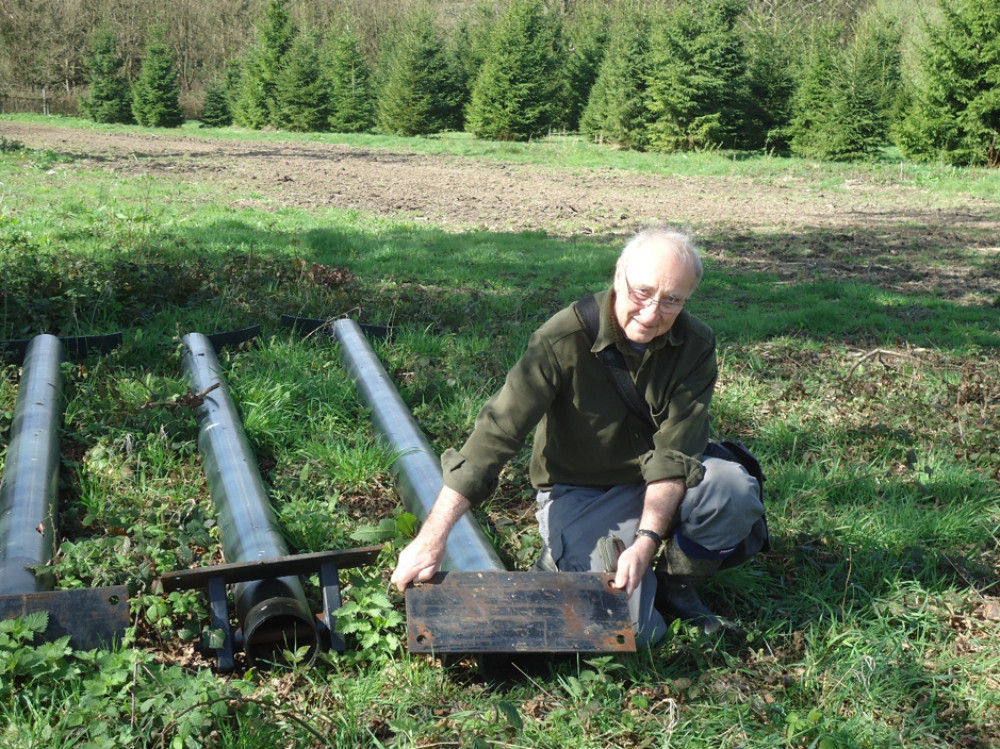
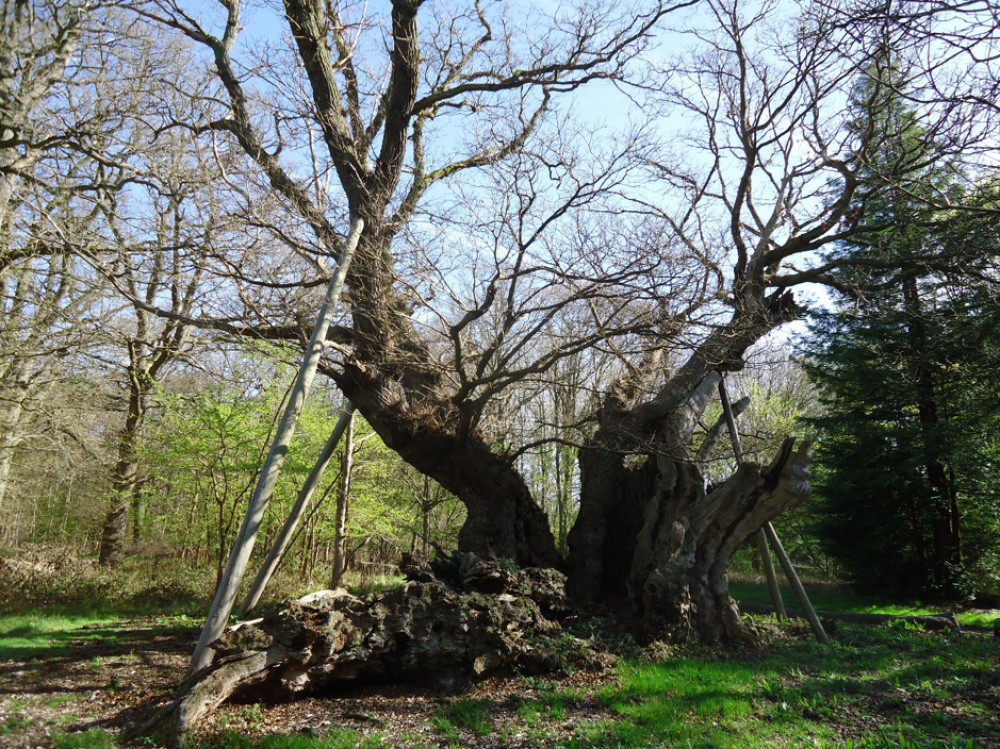
Bill also enjoys returning to Richmond, and seeing the various projects he initiated coming to fruition. When I walked the site in the summer in the company of Ted, in preparation for the visit in the autumn, I noticed that whilst some veteran trees were supported by timber poles, for one or two trees, metal poles were being used. Bill brought clarity, explaining that the timber poles were vulnerable to twisting as they dried, and they decayed with time. This affected the efficacy of the support. The metal poles don’t twist or decay, providing a more stable support.
Bill is a modest, quietly spoken gentleman. Indeed, when I first suggested an interview, he wondered whether anyone would find his journey of interest. When our conversation concluded, he wondered whether I had enough material to make a feature. I reflected on a most enjoyable conversation and looked forward to writing up my notes. May I suggest that in Bill, we have an unsung hero, who quietly did much, laid the foundations for major advances in our appreciation of trees and ancient trees, and who leaves a legacy for others to enjoy. Thank you!
Other Images