ATF visit to Llangarron Poplar
By Mark Chester
2020-04-17
This event brought together tree wardens in Herefordshire and supporters of the Ancient Tree Forum. Organised by local arboricultural consultant Jerry Ross, it took place just days after the county had suffered from Storm Dennis. Indeed, the gusty weather was such that I queried with Jerry if the event was still happening.
Our hosts were Vernon and Sheila Jones, and the first hint of a good turn out was when the over-flow car park was being used.
About fifty of us packed in to one of the outbuildings on this farm to hear talks by Jerry, Tony Norman, a farmer from the north of the county who is a lead voice on trees, and Steve Wadely, an ecologist with Monmouthshire-based AVA ecologist and bat specialist. Jerry began by explaining why Black Poplars are special. They were once popular, but the hybrid created by crossing with the American Cottonwood tree had created a cultivar (or perhaps cultivars) that grew more quickly and was therefore able to produce the timber sought from this species more readily.
Poplars were actually grown locally in Herefordshire to supply the Moreland’s ‘England’s Glory’ match factory in neighouring county Gloucestershire until it closed in the 1970s. The soft wood absorbs wax. Indeed, driving around the county today, one can still see groups of Poplars now in decline which were planted for this outlet but never harvested.
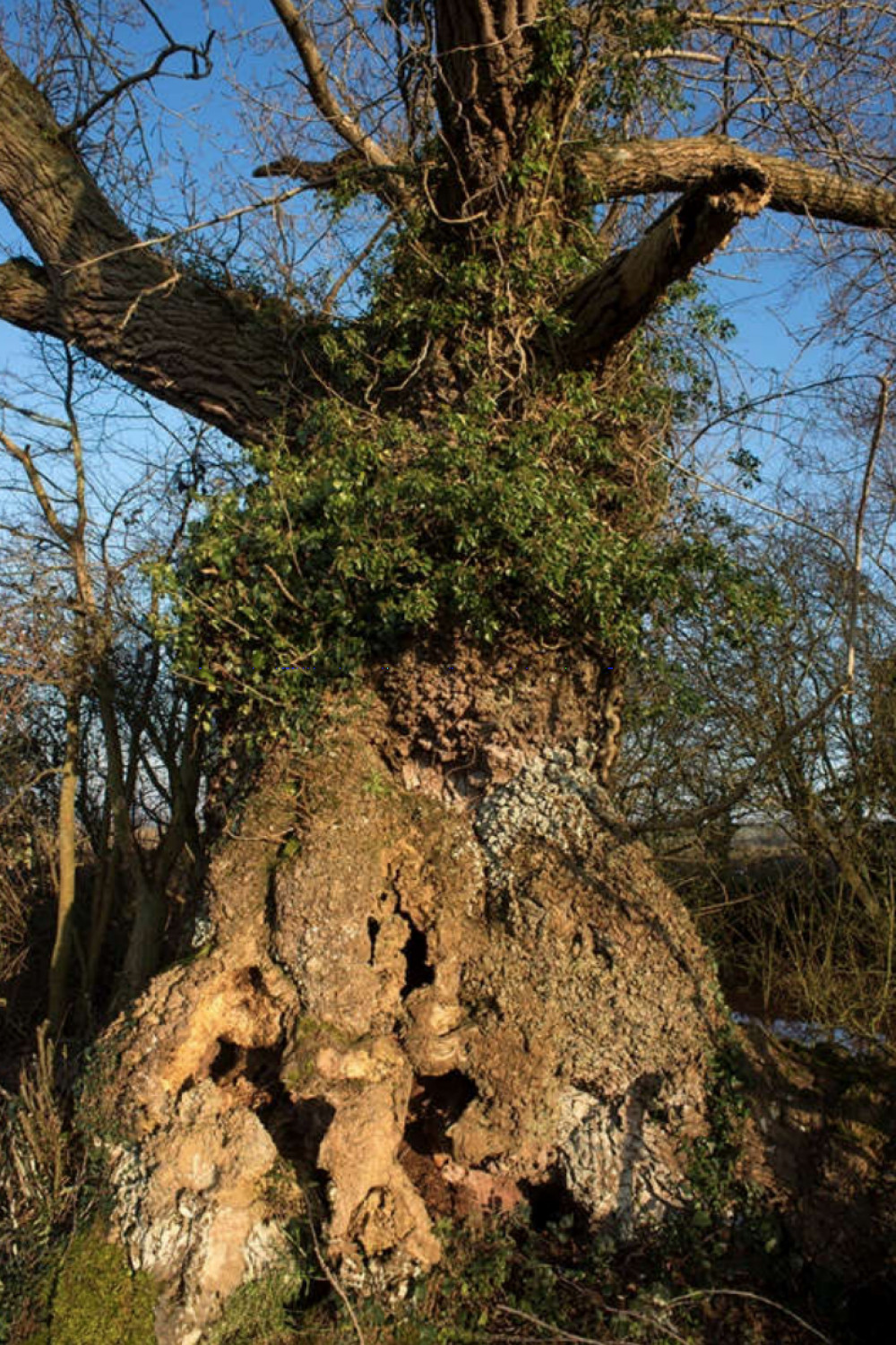
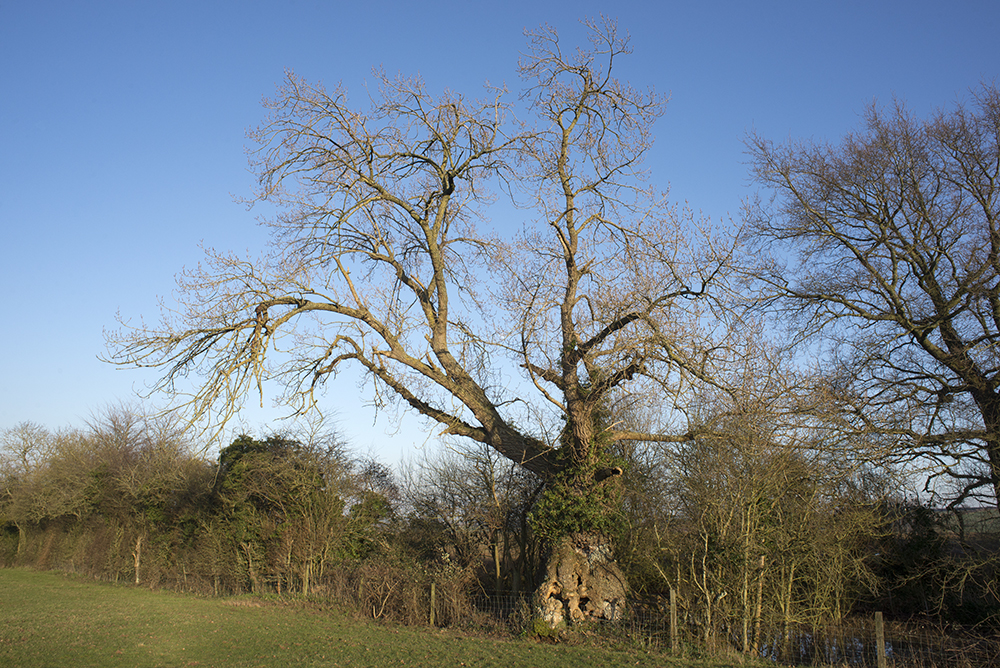
Black Poplars typically live for about 150 years, with some reaching 200. Jerry pondered whether some could live for longer, especially with pollarding which can enable them to live longer, and he estimated that the tree for which we were all gathered may have been 250 years old; a true veteran. Pollarding helps to avoid the development of large, heavy branches which can lead to failure of the tree. Jerry shared that he has seen some big old trees around the county which seem to be ‘pretty old, probably exceeding 200’. He suspects that the native tree may be less prone to failure that the hybrid, this may be a topic for others to research.
This particular specimen has not been re-pollarded for some time. Indeed, our host informed the group that he has been on the farm for nearly 70 years, and the tree has not been pruned in this time.
There are some 200 Black Poplars in the county, and a national population of 7000. This may sound a healthy number, but considering the UK tree population is measured at potential 1000 million, context is evident. Jerry explained that the plan for the day was not to re-pollard the tree, but to trim back the branch tips, thereby reducing end weight. Citing the German Frank Rimm, he shared that a 10% reduction in crown height can reduce wind sail by about 20% (based on Rimm’s own observations).
Tony Norman shared of his work mapping the Black Poplars in the county. Many have been lost in the past decade. Some have succumbed to the passage of time, others have suffered from drainage of farm land. He is now busy propagating new trees, and brought some cuttings for rooting with him. He is relying on clonal propagation as seed propagation is unreliable. There may be only three female Poplars in the county, and the seed, which is only present for a short period of time, needs to be kept moist in mud for several months. His aim is to increase the county’s Black Poplar population from 200 to 1000.
One of the challenges is that the Poplar is difficult to propagate. The seeds are produced in June and need to remain in wet, muddy conditions until October. There is a further challenge in that the female (the seed is dioecious) produces a very fluffy seed that becomes a nuisance, so the male is favoured and there are few females present. The tree has also suffered from drainage of land (it prefers wet ground).
Steve then explained why the tree is of value to ecology, especially bats. As it decays, it creates a roosting habitat for bats. Black Poplar is also often host to a fungus that degrades lignin, and this results in the creation of moist conditions in the trunk. Bats need to keep moist in the winter in order to survive. Steve then shared some possibly little known facts. Bats change their roost typically every two to three days, and may use up to 45 trees. It is not possible to say for certain if a tree is host to bats unless one spends about 45 days watching it, not something he has time to do.
We then went off to visit the star of the day. Local arboricultural contractors Acer Tree Services were ready, MEWP in place. Joe Brandt was leading the operation, and carefully assessing the weather. The team had hired a special 4 x 4 model for the occasion, which had been towed to the setting by tractor, such were the conditions. They were soon rigged up and working on the first branch, removing individual parts and exposing decay within. The aim was to prune small pieces of extension growth, thereby reducing weight on the tree. However, the gusty conditions of the early morning returned with the most frustrating of timing, and with gusts exceeding 30mph among the upper branches, and audience safety being factored in, the exercise had to be abandoned after only several branches had been pruned.
We returned to the outbuilding for a spread of tea and cakes, and a chance to have books signed by local author Archie Miles, including his tone on the Ash, and a good natter about trees. Hosting events is a fairly new experience for Jerry, who hopes to help organise more. Herefordians are in for a treat!
Other Images