ATF Summer Conference 2018. Hereford review part 2
By Mark Chester
2018-08-13
The conference was opened by session chair Chris Knapman, who began by pondering ‘what is the ATF’? In a light hearted moment, he shared that he had been exploring definitions on-line, and found that it could be the American Truckdrivers’ Federation, among others. He also wondered whether it might be ‘Ale, Trees & Food’, which sounded good to him.
Chris introduced Archie Miles as the first speaker. He provided a whistle-stop tour of some of the special trees of Herefordshire. His work has been greatly aided by the activities of a local group called the Woolhope Group. Formed in the 1860s, this was a group of local professionals who had a passion for the natural world and would organise walking parties exploring the Herefordshire countryside. They made extensive notes and took photographs, providing an invaluable archive.
The detail is such that for The Monarch oak at Holm Lacy, a note was made that there was a wild bee’s nest, and that the tree was in decline. A recent by Archie revealed the tree to be thriving now, albeit without the bees!
There can be a cultural significance to some trees. The White leaved oak marks the boundary where the three counties of Herefordshire, Worcestershire and Gloucestershire meet, and is on a section of the Lay line, a locally significant boundary, not just for trees but also culturally. Archie has spent many hours exploring the landscape around him, finding trees. Sometimes, he makes unexpected, and pleasant, discoveries. In Grenda Bishop, he found the Gospel Oak. With a girth of 42 feet, it is the joint British record holder. He met the land-owner, who appreciates that this is a special tree, and had fenced the area around it for protection. His main concern was how best to manage the tree, and the only action required was to extend the fenced area. Like many of our special trees, this specimen is on private land, but the landowner has been persuaded to provide a permissive access so that tree enthusiasts can visit.
No tour of the trees of Herefordshire is complete without a visit to Croft Castle, and the famous Sweet Chestnuts. They form a triple avenue, which is a unique feature. Their history has intrigued and perplexed generations, with the traditional view of them having been planted to commemorate the defeat of the Spanish Armada being challenged in recent times, Archie observed that the layout looks like that of an orchard; was seed production its main purpose?
As the tour concluded (or rather, the ticking clock signalled the end of the lecture slot), Archie mentioned the Black Poplar at Ewyas Harold, which is growing very close to the village Fish & Chip shop, and is locally famous. He also mentioned a crab apple at Midsummer Hill in the Malvern Hills. Whilst technically not in the county, it is worthy of mention for a possibly remarkable history. The site is an Iron Age hill fort, and the fruit produced is rather distinctive. Could it be descended from fruit enjoyed by the inhabitants of 2000 years earlier?
Archie is a really engaging speaker who can hold an audience for an extended period, and his time was over too soon. He shared some of the challenges he faces, such as lighting when photographing Yew, and getting out to visit treasures before they are lost. On one occasion, he photographed a tree and was unaware of the feline guest who was captured in the image. Several years later, he was contacted by the owner of the cat, who had found the postcard made from the image. The cat had since passed away, and the owner wish to purchase many copies of the postcard to send to friends and family!
Reg Harris followed. He is happiest when working in trees, and is often working on veteran trees. He has identified a problem when working on lapsed pollards, which may have little growth on the bole and thus be ill-equipped to respond to work retrenchment work. He cited the example of an oak which was worked for centuries, being pollarded on a cyclical basis. The pollarding had ceased over 100 years earlier, and the tree is now top heavy, with decay. He has been exploring ways to encourage regeneration, based on a theory by Neville Fay. Could internodal cuts and a crown reduction phased over several decades be the solution? Reg’s experience was that this wasn’t happening, and instead, localised suckering is occurring, which is not helpful.
The phased approach consists of two more limited cuts, the first removing branches at 50mm diameter, the second removing slightly larger branches. The third would be more substantial, potentially removing much of the crown. The third cut is pending for some trees, and Reg’s observation is that this may not be appropriate for these trees. For some trees, there has been suckering and the aim of generating growth lower in the tree is not happening. There could be loss of habitat. Reg concluded that it was time to review the approach. One senses that this is a work in progress. However, with his passion for the topic, the research would seem to be in good hands
Frits Giellssen faces a very different situation, working on trees in Northern mainland Europe. There are few veteran trees to be found, and much less appreciation for them. The view is often that the tree is old, let’s fell and plant something younger! Bracing is also encouraged, even when the installation is not going to be maintained. He has found installations that are 40 years old and not touched since installation, even when the manufacturer advises they should be adjusted every five years! For one tree, he managed to extract 13 metres of steel! Frits presented examples of his worked, and how he is trying to manage older trees. One surprising element (for me) was that some of the trees being worked on seemed to be rather moderate and unsuited for retention. For Frits, this is an anomaly he regularly faces.
After a coffee break, Megan Climber shared about Woodland Pasture, why it matters and the challenges of management. This is where ancient trees are in a pasture setting. She referred to the resource in the UK as being comparable to rainforests, being invaluable. The basic principles of management are that dead wood should be maintained wherever possible and pruning kept to a minimum. The use of traditional breeds to graze the grass is ideal, avoiding higher densities of stock. The cattle are there to manage the grass and not on a commercial basis.
Dr. Keith Alexander followed, sharing on his work on the Cosnards Net winged beetle and its presence (or otherwise) in the Wye Valley. This is a very rare species, with only two known populations in the UK prior to a discovery in 2017 (it had been seen at Wye Gorge in 1944!) His work has been frustrated by how little we know about this beetle. On one occasion recently, he had spent his normal working day surveying for it, without success. Then colleagues visited the site in the evening and found a group of males enjoying the evening sun!
Kylie Mellor then updated on the new website. The original website pre-dated smartphones and the new one is now much more user-friendly. It is now ‘a living database of ancient, veteran and notable trees, a source of citizen science’. More verifiers are needed, and a new focus on surveying is now needed.
Victoria Grainger concluded the morning of seminars with an update on her research. She is studying for a PhD on the database of the Ancient Tree Inventory in order to identify gaps in our records. One of the key elements that she is exploring is how representative is the data we have of the national population. Her initial conclusions are that surveying to date has been based on factors such as how accessible sites are, and how pleasant to visit, and not on where the major populations are. For example, an area in North Herefordshire has been extensively surveyed mainly because it is a SSSI to which there is public access, and the setting makes for a pleasant walk!
The evidence is that half of our veteran trees are in parkland and woodland pastures, yet only 10% of those surveyed are in such settings. One of the purposes of her work is to predict future surveying locations, and to generate momentum for further surveying.
The afternoon visit was to Kentchurch Court. The trip was introduced by the Head Gardener, who explained that the history of the site was quite representative of the UK. Originally a Royal Hunting Park, it was then passed to the Church via the Knights Templar. It was then acquired by the Scudamore family, who have owned it for nearly 1000 years. Management priorities have ranged from pleasure to timber production to manicured landscape, and everything in between. The current priority is for ecology, one which previous generations would have resisted!
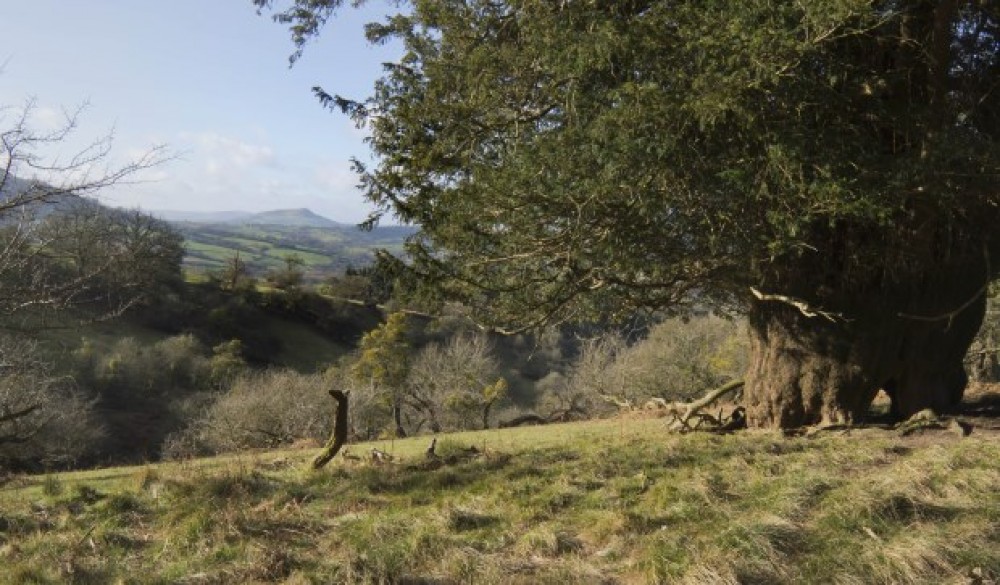
Such was the size of the group in attendance that we toured in three groups. My group was led by Archie Miles and Rosie, daughter of the current owners. One of the memorable features is a group of Scots Pines which were, apparently, a sign than Jacobites would be welcome! A bonus for me was a Tulip tree in flower, which I have not previously seen. We also spent time looking at one rather substantial Beech tree complete with included bark and an array of fungi emerging in key places across the trunk, an indication of challenges ahead. There was an impromptu discussion of management and an appreciation of the need for some intervention if the tree is to be retained as a feature of the future.
Kentchurch Court is a venue where one could easily spend more than the allotted hour exploring, and this doesn’t include a tour of the walled gardens!
Day two of the conference will be reviewed next month.