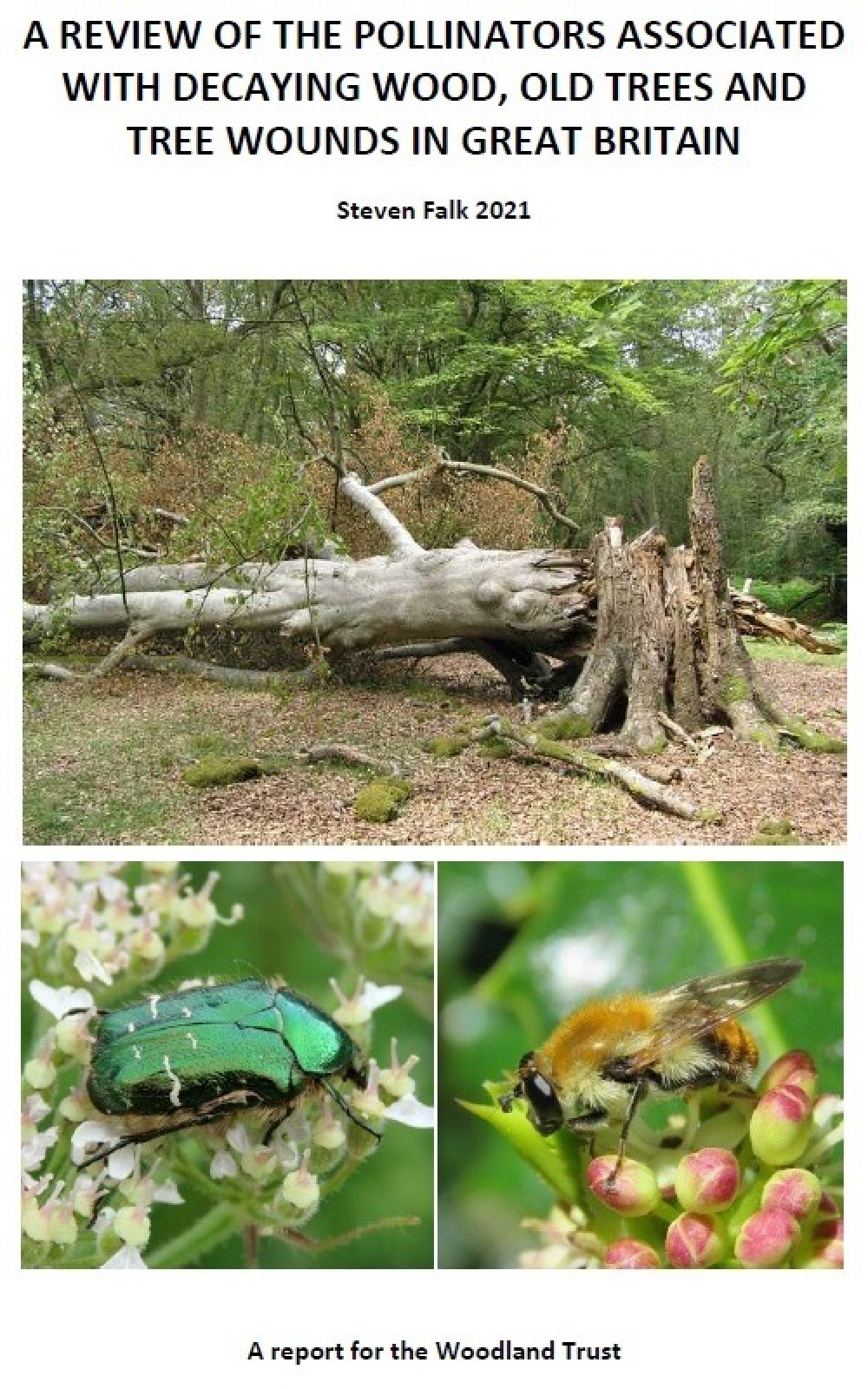
A Review of the Pollinators associated with decaying wood, old trees and tree wounds in Great Britain
By Steven Falk
2021-04-05
Pollinating insects and saproxylic insects are two large and important ecological assemblages within Britain's biodiversity, with perhaps 6,000 species in the former category and 2,000 species in the latter. But they are not mutually exclusive categories because some saproxylic insects have flower-visiting adults, notably various longhorn beetles, chafer beetles, click beetles, hoverflies, and wood-nesting bees and wasps.
In 2020, the Woodland Trust commissioned entomologist and tree expert, Steven Falk, to review all the potential 'saproxylic pollinators' of England, Wales and Scotland to help assess the size, status and conservation requirements of this fauna. The report was published in February 2021 and lists some 320 species, providing information on their lifecycles, the flowers they visit, their distribution, their status and their conservation needs. The report highlights that a high proportion of saproxylic pollinators are scarce, restricted and declining. Several, such as the Pine Hoverfly Blera fallax and Violet Click Beetle Limoniscus violaceus are now critically Endangered and require a fair bit of interventional conservation to keep them here in Britain. The report highlights the tremendous variety of blossoms and flowers used by saproxylic pollinators whilst also emphasising the overwhelming importance of Goat Willow, Blackthorn, Cherry, Hawthorn, and common-place flowers such as Cow Parsley, Hogweed, Bramble, Creeping Thistle and Ivy. It is very easy to remove such floral resources at a site through insensitive management. The report can be downloaded from Researchgate:
Steven has also placed several other interesting tree-related reports in his Researchgate portfolio (including a Warwickshire tree catalogue and an account of Warwickshire's veteran trees):
https://www.researchgate.net/profile/Steven-Falk-2/publications
Meanwhile, The Ancient Tree Forum https://www.ancienttreeforum.org.uk/ has been carrying out work to revise, update and republish their Ancient Tree Guides, an invaluable resource for anyone involved with ancient, or indeed with any trees. Guide no. 4, "What are Ancient, Veteran and other Trees of Special Interest?" is being revised with the intention of clarifying the criteria by which veterans can be recognised. The current versions of all the guides can be downloaded by clicking here.
In a similar vein are a couple of Swiss publications that also help in the recognition of "special features of trees that are particularly valuable for the habitats they provide". These micro-habitats [are] small life-sites borne by some trees, which are indispensable for thousands of specialised organisms". The authors call trees with such characteristics 'Habitat Trees' but in many respects they are equivalent to our Veteran trees. Fact Sheet 64, Know, protect and promote habitat trees does what it says on the label, while the Field guide to tree-related microhabitats describes in detail these various micro-habitats, explaining their significance as well as providing details of how to recognise them. Both are free to download as PDFs, the Field guide to tree-related microhabitats and Know, protect and promote habitat trees .'
Other News
National media has been picking up on Housing Secretary Robert Jenrick's recent announcement that all new UK streets are set to be lined with trees to make more beautiful neighbourhoods and all local authorities must develop design codes to 'reflect what local communities truly want'. Nottingham is considering going one better to not just create a few new green streets but a whole new city centre park where currently post 60's dereliction remains. But if you've ever tried to walk to their city centre from the train station, you'd know why this is a popular idea locally....
And let's not forget Hedges and Shrubs in the redesign toolbox for healthier streets: As reported on Radio 4 this week: 'Experts identify 'super-plant' that absorbs roadside air pollution .'
TDAG: Regarding urban tree design, planting and management, local authorities - and the rest of us - can't go far wrong by referring to the excellent Trees and Design Action Group (TDAG) publications for advice listed here Their Trees in the Townscape gives invaluable information on good practice covering all aspects from planning to post-planting tree management, all set out in 12 PRINCIPLES OF TREE PLANTING. With a particular focus on local authorities, these clearly set out the measures that local authorities can adopt to provide more and better trees and also to improve development practices in relation to trees. Divided into four sub-headings, the twelve principles are:
PLAN:
- Know your Tree Resource
- Have a comprehensive Tree Strategy
- Embed Trees into Policy and Other Plans
DESIGN
- Make Tree-Friendly Places
- Pick the Right Trees
- Seek Multiple Benefits
PLANT/PROTECT:
- Procure a Healthy Tree
- Provide Soil, Air and Water
- Create Stakeholders
MANAGE/MONITOR:
- Take an Asset Management Approach
- Be Risk Aware (rather than Risk Averse)
- Adjust Management to Needs
Amongst its specific recommendations are the following:
- Establish tree replacement and compensation measures that make it cheaper for new developments to keep existing large trees rather than fell them:
It is only when a tree reaches and lives through a mature stage that the return on the investment made to plant and care for that tree is realised. Depending on species, it takes between 15 and 40 years for a tree to grow a sufficiently large canopy to deliver meaningful aesthetic, air pollution removal, rainwater management, and other benefits. From a nature conservation perspective, the older a tree, the richer its wildlife. As a result, even when the planting of a new tree compensates for the felling of an older one, a significant loss is incurred.
It is in recognition of that loss that more and more local authorities, as well as socially and environmentally responsible built environment professionals are adopting tree replacement and compensation measures going far beyond one for one, as exemplified in the Bristol case study. Leadership in this matter can also be found in the private sector.
- Set tree planting standards for new developments:
Setting tree planting standards provides an effective mechanism to ensure that new developments contribute to the green infrastructure that makes towns and cities more pleasant and effective places to live and do business. Having adopted tree planting standards also enables the collection of commuted sum payments, in lieu of tree planting, when circumstances preclude the requirement to be met on site. This can provide a meaningful complement to a local authority's budget for tree planting.
For enhanced effectiveness, such planting standards should be complemented with soil volume requirements, particularly for trees planted in hard landscapes in dense urban environments (Details of these requirements form the basis of Principle 8, ' Provide Soil, Air and Water')
Other Images